Getting Around Rules on Lobbying
Despite New Law, Firms Find Ways To Ply Politicians
By Elizabeth WilliamsonWashington Post Staff Writer Sunday, October 14, 2007; Page A01
In recent days, about 100 members of Congress and hundreds of Hill staffers attended two black-tie galas, many of them as guests of corporations and lobbyists that paid as much as $2,500 per ticket.
Because accepting such gifts from special interests is now illegal, the companies did not hand the tickets directly to lawmakers or staffers. Instead, the companies donated the tickets back to the charity sponsors, with the names of recipients they wanted to see and sit with at the galas.
The arrangement was one of the most visible efforts, but hardly the only one, to get around new rules passed by Congress this summer limiting meals, travel, gifts and campaign contributions from lobbyists and companies that employ them.
Last week, Senate Majority Leader Harry M. Reid (D-Nev.) and Republican leader Mitch McConnell (Ky.) found bipartisan agreement on maintaining one special privilege. Together they put language into a defense appropriations bill that would keep legal the practice of some senators of booking several flights on days they return home, keeping the most convenient reservation and dumping the rest without paying cancellation fees -- a practice some airlines say could violate the new law.
Senators also have granted themselves a grace period on requirements that they pay pricey charter rates for private jet travel. Lobbyists continue to bundle political contributions to lawmakers but are now making sure the totals do not trigger new public reporting rules. And with presidential nominating conventions coming next summer, lawmakers and lobbyists are working together to save another tradition endangered by the new rules: the convention party feting (celebrating) one lawmaker.
"You can't have a party honoring a specific member. It's clear to me -- but it's not clear to everybody," said Barbara Boxer (D-Calif.), chairman of the Senate ethics committee. She said the committee is getting "these questions that surround the edges -- 'If it's midnight the night before,' 'If I wear one shoe and not the other.' "
Democrats touted the new ethics law as the most thorough housecleaning since Watergate, and needed after a host of scandals during 12 years of Republican rule. Prompted by disgraced lobbyist Jack Abramoff's wheeling and dealing and the jailing of three members of Congress on corruption charges in recent years, the law, signed by President Bush on Sept. 14, was heralded by congressional leaders as a real change in Washington's influence game.
But the changes have prompted anxiety about what perks are still permissible. In recent months, the House and Senate ethics committees have fielded more than 1,000 questions from lobbyists and congressional staffers seeking guidance -- or an outright waiver -- for rules banning weekend trips and pricey wedding gifts, five-course dinners and backstage passes.
Looking for ways to keep spreading freebies legally, hundreds of lobbyists have been attending seminars at Washington law firms to learn the ins and outs of the new law.
At a recent American League of Lobbyists briefing, Cleta Mitchell of the Foley & Lardner law firm said that while the law bans lobbyists from buying lawmakers or staffers a meal, it is silent on picking up bar tabs. A woman in the third row asked hopefully, "You can buy them as many drinks as you want, as often as you want?"
No, Mitchell said, not unless the drinkers are the lobbyist's personal friends, and she pays from her own pocket.
If that rule was clear to some, two charity dinners allowed hazier interpretations.
(...this article continues at www.washingtonpost.com)
http://www.washingtonpost.com/wp-dyn/content/article/2007/10/13/AR2007101301275.html
Sunday, October 14, 2007

Sunday, September 30, 2007
Analysis: Do you think the country is ready for a President Romney?
Check out the article that you can link to via the following Hypertext Markup Language:
Mitt's Mission
http://www.msnbc.msn.com/id/21049285/site/newsweek/
Mitt's Mission
http://www.msnbc.msn.com/id/21049285/site/newsweek/
Sunday, September 23, 2007
Analysis: How will things change at the Justice Department if Judge Mukasey is confirmed by the Senate?
Rulings by Mukasey Are Called Conservative, Fair
By Robert Barnes and Michael A. FletcherWashington Post Staff Writers Friday, September 21, 2007; Page A03
Judge Michael B. Mukasey clearly believed that the defendant did not have a case. He dismissed her assertion that the New York City Police Department fired her because she had accused a more senior officer of rape, without allowing a jury to hear the case. But a higher court disagreed and told the judge to hold a trial.
There, the jury found for Karen Sorlucco, and ordered the police department to pay her nearly $265,000. But again Mukasey disagreed, making a rare decision to overturn the jury's verdict, partly because he believed that the victim had committed perjury. "It would be grossly unjust for the jury verdict to stand," the judge said.
And, again, a higher court disagreed: "The trial court overstepped its bounds, and usurped the jury's function of judging credibility." It ordered Mukasey to enter judgment in Sorlucco's favor.
The case, finally settled in 1992, fairly early in Mukasey's career on the bench, showed a judge insistent on doing what he felt the law compelled, even when a jury and a higher court disagreed. "It's difficult whenever a judge takes away a jury verdict, but he was doing his job as he saw it," said Minna J. Kotkin, a professor at Brooklyn Law School, whose legal clinic handled Sorlucco's appeal. She added, "I don't think civil rights has been his first love."
Many lawyers who have practiced before Mukasey, 66, describe him as conservative but not doctrinaire, and fair. The long judicial record created by Mukasey's 18 years as judge on the U. S. District Court for the Southern District of New York included thousands of cases that ranged from high-profile terrorism trials to lengthy insurance battles over liability in the Sept. 11, 2001, attacks on the twin towers, and a case in which a jury awarded $100 to a woman who said boxer Mike Tyson grabbed her buttocks.
His generally conservative demeanor on the bench and his self-confidence seem particularly pronounced in his handling of the complex trial of Omar Abdel Rahman, the "blind sheik," after the 1993 bombing of the World Trade Center. After a long Rahman complaint at sentencing, he said: "You should be assured that there is no shortage of will in this country to deal with the threat of violence from any source. If you look at the record of even the relatively recent past -- the last 50 years of this country -- you will find that this country has faced militant fascism, and prevailed; it faced militant communism, and prevailed."
Mukasey also told Rahman: "The one thing that the sentence in this case will certainly assure to the citizens of this city and of this country, who deserve it, is that you and the others who are being sentenced here will never be in a position to do again what the evidence showed overwhelmingly that you did in this case."
While many commentators saw that trial, and Mukasey's handling of another case involving terrorist Jose Padilla, as models of jurisprudence in handling terrorism suspects, Mukasey came away from his experience deeply skeptical that the current criminal justice system is up to that relatively new task. He has since suggested that a separate national court might be needed for such cases.
"Khalid Sheikh Mohammed, the mastermind of the 9/11 attacks, is said to have told his American captors that he wanted a lawyer and would see them in court," Mukasey wrote last month. "If the Supreme Court rules . . . that foreigners in U.S. custody enjoy the protection of our Constitution regardless of the place or circumstances of their apprehension, this bold joke could become a reality." His statement matched the Bush administration's view.
In another op-ed column, Mukasey said he agrees with the proposition that government "is entitled, at least in the first instance, to receive from its citizens the benefit of the doubt." But while Mukasey ruled that he supported the administration's detention of Padilla as an "enemy combatant," he showed independence by ruling over the administration's objections that Padilla had the right to an attorney.
In a later case, Mukasey also ruled against a government bid to administer drugs to Susan Lindauer, a mentally unstable woman who had been charged as an agent of Iraq, to be able to try her in court.
Roland Thau, a federal public defender in Manhattan who has appeared before Mukasey, said: "He gave you a very good trial. He is very sharp, very focused. It was interesting to argue before him because he was interested in ideas and language."
(this article continues at www.washingtonpost.com)
Thursday, September 13, 2007
Opinion: Is the plan that the president announced a good idea?

WASHINGTON (CNN) -- President Bush said Thursday night conditions on the ground in Iraq have improved sufficiently to start bringing some U.S. troops home, and urged Americans divided over the war to "come together."
In a televised speech to the nation, Bush said he would reduce U.S. force strength by 5,700 troops by Christmas and, by next July, reduce the number of combat brigades from 20 to 15, a decrease of roughly 30,000 troops.
The first step in that process will come later this month, when 2,200 Marines leaving Anbar province will not be replaced, the president said.
"The principle guiding my decisions on troop levels in Iraq is 'return on success' -- the more successful we are, the more American troops can return home," Bush said during a 17-minute address from the Oval Office.
"In all we do, I will ensure that our commanders on the ground have the troops and flexibility they need to defeat the enemy."
The top U.S. commander in Iraq, Gen. David Petraeus, and U.S. Ambassador to Iraq Ryan Crocker told Congress this week that progress had been made on the ground in Iraq since Bush in January sent 30,000 additional troops. The move was termed "the surge."
Petraeus said the surge campaign has met its military goals of reducing sectarian killings by more than 50 percent nationwide and by more than 80 percent in Baghdad.
Friday, August 17, 2007
Analysis: What impact will the Rove departure have on the White House and politics in general?
As Rove Departs, President Again Turns to Gillespie
By Michael A. FletcherWashington Post Staff WriterThursday, August 16, 2007
CRAWFORD, Tex., Aug. 15 -- When George W. Bush needed a communications adviser during the 2000 Florida recount, which determined whether he would be president, he turned to Ed Gillespie. When Bush needed someone to shepherd two of his Supreme Court nominees, he again called on Gillespie. And when longtime confidant and counselor Dan Bartlett stepped down this summer, Bush brought Gillespie to the White House.
Now, with the departure of Karl Rove, the president's closest adviser, Gillespie, 46, a former lobbyist and Republican National Committee chairman, has once again been asked to help fill the void.
(...this story continues at www.washingtonpost.com)
Sunday, August 05, 2007
Analysis: Is there a significant difference between the previous Republican-controlled Congress and the current Democratic-controlled Congress?
Explanatory Note: In the 2006 elections many voters seemed to vote for Democrats because they thought the policies in Iraq would change. In addition, many on the left thought a Democratic-controlled Congress would change what they perceived as violations of the principles of the Bill of Rights. With the current policy in Iraq and the information from the article below in mind, analyze whether or not there are any real differences in substance between the leadership of the two parties.
House Approves Wiretap Measure
White House Bill Boosts Warrantless Surveillance
By Ellen Nakashima and Joby WarrickWashington Post Staff WritersSunday, August 5, 2007
The Democratic-controlled House last night approved and sent to President Bush for his signature legislation written by his intelligence advisers to enhance their ability to intercept the electronic communications of foreigners without a court order.
The 227 to 183 House vote capped a high-pressure campaign by the White House to change the nation's wiretap law, in which the administration capitalized on Democrats' fears of being branded weak on terrorism and on a general congressional desire to act on the measure before an August recess.
The Senate had passed the legislation Friday night after House Democrats failed to win enough votes to pass a narrower revision of a statute known as the Foreign Intelligence Surveillance Act. The original statute was enacted after the revelation of CIA abuses in the 1970s, and it required judicial oversight for most federal wiretapping conducted in the United States.
Privacy and civil liberties advocates, and many Democratic lawmakers, complained that the Bush administration's revisions of the law could breach constitutional protections against government intrusion. But the administration, aided by Republican congressional leaders, suggested that a failure to approve what intelligence officials sought could expose the country to a greater risk of terrorist attacks.
Democrats facing reelection next year in conservative districts helped propel the bill to a quick approval. Adding to the pressures they felt were recent intelligence reports about threatening new al-Qaeda activity in Pakistan and the disclosure by House Minority Leader John A. Boehner (R-Ohio) of a secret court ruling earlier this year that complicated the wiretapping of purely foreign communications that happen to pass through a communications node on U.S. soil.
The bill would give the National Security Agency the right to collect such communications in the future without a warrant. But it goes further than that: It also would allow the interception and recording of electronic communications involving, at least in part, people "reasonably believed to be outside the United States" without a court's order or oversight.
White House spokesman Tony Fratto emphasized that the bill is not meant to increase eavesdropping on Americans or "to affect in any way the legitimate privacy rights" of U.S. citizens. Data related to Americans in communications with foreigners who are the targets of a U.S. terrorism investigation could be monitored only if intelligence officials have a reasonable expectation of learning information relevant to that probe, a senior U.S. official said.
"There are a lot of people who felt we had to pass something," said one angry Democratic lawmaker who spoke on the condition of anonymity, citing the sensitivity of caucus discussions. "It was tantamount to being railroaded."
In a sole substantial concession to Democrats, the administration agreed to a provision allowing the legislation to be reconsidered in six months.
Some House Democrats were still upset by what they saw as a deliberate scuttling by the White House of negotiations on a compromise bill. On Thursday, Democratic leaders reached what they believed was a deal with the government's chief intelligence official, Director of National Intelligence Mike McConnell, only to be presented with a new list of conditions at the last minute. The White House and McConnell have denied that a deal had been reached.
"I think the White House didn't want to take 'yes' for an answer from the Democrats," said Rep. Jan Schakowsky (D-Ill.), an intelligence committee member.
The administration said that its bill is aimed at bringing the Foreign Intelligence Surveillance Act of 1978 into step with advances in technology, primarily by restoring the government's power to gather without a warrant foreign intelligence on targets located overseas.
(this article continues...go to www.washingtonpost.com)
Sunday, July 22, 2007
Opinion: Who won the Democratic Debate (and who did well or poorly in the debate?)

Democratic Debate: Monday July 23, 6:00 p.m. (our time) on CNN
Republican Debate: September 17 on CNN
* Bonus Question (not as important as the politics question and is only asked as an aside about the state of the media and the "young viewer")
Do you care that the questions are submitted on YouTube or is it a publicity stunt that is not a real change in the way that major networks report the news? Is this an exciting change that will make the news more interactive or not?
Monday, July 16, 2007
Tuesday, July 03, 2007
Analysis: Do you think the president's decision will have any political impact on him or the presidential candidates?
By BEN FELLER, Associated Press Writer
WASHINGTON - President Bush spared former White House aide I. Lewis "Scooter" Libby from a 2 1/2-year prison term in the CIA leak investigation Monday, delivering a political thunderbolt in the highly charged criminal case. Bush said the sentence was just too harsh.
Bush's move came just five hours after a federal appeals panel ruled that Libby could not delay his prison term. That meant Libby was likely to have to report soon, and it put new pressure on the president, who had been sidestepping calls by Libby's allies to pardon Vice President Dick Cheney's former chief of staff.
"I respect the jury's verdict," Bush said in a statement. "But I have concluded that the prison sentence given to Mr. Libby is excessive. Therefore, I am commuting the portion of Mr. Libby's sentence that required him to spend thirty months in prison."
Special Prosecutor Patrick Fitzgerald disputed the president's assertion that the prison term was excessive. Libby was sentenced under the same laws as other criminals, Fitzgerald said. "It is fundamental to the rule of law that all citizens stand before the bar of justice as equals," the prosecutor said.
Libby's attorney, Theodore Wells, said in a statement that the Libby family was grateful for Bush's action and continued to believe in his innocence.
Bush's decision enraged Democrats and cheered conservatives — though some of the latter wished Bush had granted a full pardon.
"Libby's conviction was the one faint glimmer of accountability for White House efforts to manipulate intelligence and silence critics of the Iraq war," said Senate Majority Leader Harry Reid. "Now, even that small bit of justice has been undone."
House Speaker Nancy Pelosi, D-Calif., said Bush's decision showed the president "condones criminal conduct."
Unlike a pardon, which would have wiped away Libby's criminal record, Bush's commutation voided only the prison term.
The president left intact a $250,000 fine and two years' probation for his conviction of lying and obstructing justice in a probe into the leak of a CIA operative's identity. The former operative, Valerie Plame, contends the White House was trying to discredit her husband, a critic of Bush's Iraq policy.
Bush said his action still "leaves in place a harsh punishment for Mr. Libby."
Libby was convicted in March, the highest-ranking White House official ordered to prison since the Iran-Contra affair roiled the Reagan administration in the 1980s. Arms were secretly sold to Iran to gain freedom for American hostages, with the money funneled to anti-communist guerrillas in Nicaragua in spite of a congressional ban. Bush's father, former President George H.W. Bush, issued pardons for six former officials shortly before leaving office in 1992.
Testimony in the Libby case revealed the extraordinary steps that Bush and Cheney were willing to take to discredit a critic of the Iraq war.
Libby's supporters celebrated the president's decision. "President Bush did the right thing today in commuting the prison term for Scooter Libby," said House Republican Whip Roy Blunt of Missouri.
"That's fantastic. It's a great relief," said former Ambassador Richard Carlson, who helped raise millions for Libby's defense fund. "Scooter Libby did not deserve to go to prison and I'm glad the president had the courage to do this."
Already at record lows in the polls, Bush risked a political backlash with his decision. President Ford tumbled in the polls after his 1974 pardon of Richard M. Nixon, and the decision was a factor in Ford's loss in the 1976 presidential election.
White House officials said Bush knew he could take political heat and simply did what he thought was right. They would not say what advice Cheney might have given the president.
On the other hand, Bush's action could help Republican presidential candidates by letting them off the hook on the question of whether they would pardon Libby. Bush said Cheney's former aide was not getting off free.
"The reputation he gained through his years of public service and professional work in the legal community is forever damaged," Bush said. "His wife and young children have also suffered immensely. He will remain on probation. The significant fines imposed by the judge will remain in effect. The consequences of his felony conviction on his former life as a lawyer, public servant and private citizen will be long-lasting."
A spokeswoman for Cheney said simply, "The vice president supports the president's decision."
The White House said Bush came to his decision in the past week or two and made it final Monday because of the ruling of the appeals panel, which meant Libby would be going to prison soon.
The president's announcement came just as prison seemed likely for Libby. He recently lost an appeals court fight that was his best chance to put the sentence on hold, and the U.S. Bureau of Prisons had already designated him inmate No. 28301-016.
Bush's statement made no mention of the term "pardon," and he made clear that he was not willing to wipe away all penalties for Libby.
The president noted Libby supporters' argument that the punishment did not fit the crime for a "first-time offender with years of exceptional public service."
Yet, he added: "Others point out that a jury of citizens weighed all the evidence and listened to all the testimony and found Mr. Libby guilty of perjury and obstructing justice. They argue, correctly, that our entire system of justice relies on people telling the truth. And if a person does not tell the truth, particularly if he serves in government and holds the public trust, he must be held accountable." Bush then stripped away the prison time.
The leak case has hung over the White House for years. After CIA operative Valerie Plame's name appeared in a 2003 syndicated newspaper column, Special Prosecutor Fitzgerald questioned top administration officials, including Bush and Cheney, about their possible roles.
Nobody was ever charged with the leak, including Deputy Secretary of State Richard Armitage or White House political adviser Karl Rove, who provided the information for the original article. Prosecutors said Libby obstructed the investigation by lying about how he learned about Plame and whom he told.
Plame believes Libby and other White House officials conspired to leak her identity to reporters in 2003 as retribution against her husband, Joseph Wilson, who criticized what he said was the administration's misleading use of prewar intelligence on Iraq.
Attorney William Jeffress said he had spoken to Libby briefly by phone and "I'm happy at least that Scooter will be spared any prison time. ... The prison sentence was imminent, but obviously the conviction itself is a heavy blow to Scooter."
A White House official notified the trial judge, U.S. District Judge Reggie B. Walton, of the decision. Walton, a Bush appointee who served in the White House under the president's father, had cited the "overwhelming" evidence against Libby when he handed down his sentence. A courthouse spokesman said Walton would not comment.
___
Associated Press writer Matt Apuzzo contributed to this report.
Sunday, June 03, 2007
Opinion: Should public policy decisions be made to address global warming?
As the World Warms, the White House Aspires
By Dana MilbankFriday, June 1, 2007 (from WashingtonPost.com)
Yesterday, as the temperature pushed toward 90 degrees in the capital, global warming caused a meltdown in the Bush administration's message machine.
Just as President Bush was about to wheel out his "new international climate change framework," the NASA administrator, Michael Griffin, declared that there is no need to take action against global warming.
"Whether that is a long-term concern or not, I can't say," he said in an interview with National Public Radio, adding: "I am not sure that it is fair to say that it is a problem we must wrestle with." In fact, Griffin found it "rather arrogant" to suggest that global warming is a bad thing.
A couple of hours after the broadcast, Griffin's boss took the stage at the Ronald Reagan Building to endorse just such arrogance -- an initiative aimed at reducing greenhouse gases. "The United States takes this issue seriously," Bush said.
This mixed message led to a rather cool reception for Jim Connaughton, the president's adviser on the environment, as he briefed reporters on the plan at noon.
"Will the new framework consist of binding commitments or voluntary commitments?" asked CBS News's Jim Axelrod.
"In this instance, you have a long-term, aspirational goal," Connaughton answered.
Aspirational goal? Like having the body you want without diet or exercise? Or getting rich without working?
"I'm confused," Axelrod said. "Does that mean there will be targets for greenhouse gas emission reductions, and that everybody will be making binding commitments?"
"The commitment at the international level will be to a long-term, aspirational goal," the Bush aide repeated.
Axelrod had his answer. "Voluntary," he concluded.
"Well," said Connaughton, "I want to be careful about the word 'voluntary.' "
Saturday, May 26, 2007
Opinion: If, like MHS grad Elliott Anderson, you were delivering a Memorial Day address, what would you say to the nation?
Bush pays tribute to fallen U.S. troops
By DEB RIECHMANN, Associated Press
President Bush urged Americans to use Memorial Day to rededicate themselves to fighting for freedom around the world and pray for the safety of U.S. troops serving overseas.
"In Iraq and Afghanistan, millions have shown their desire to be free," Bush said Saturday in his weekly radio address. "We are determined to help them secure their liberty. "
On Monday, Bush will mark his sixth Memorial Day as a wartime president with a visit to Arlington National Cemetery. He is to lay a wreath at the Tomb of the Unknowns to honor those who have died in past and current conflicts.
"From Valley Forge to Vietnam, from Kuwait to Kandahar, from Berlin to Baghdad, brave men and women have given up their own futures so that others might have a future of freedom," he said. "Because of their sacrifice, millions here and around the world enjoy the blessings of liberty. And wherever these patriots rest, we offer them the respect and gratitude of our nation."
Bush used his radio address to tell the story of Sgt. David Christoff Jr. of Rossford, Ohio, one of at least 3,431 members of the U.S. military who have died since the beginning of the Iraq war in March 2003. Christoff signed up for the Marines the day after the Sept. 11 attacks in 2001, saying he didn't want his brother and sister to "live in fear," Bush said.
Christoff was deployed to Iraq, where he fought in street battles in Fallujah and earned a Purple Heart for wounds suffered in action. He returned to Iraq and was killed last May in the volatile Anbar province.
"When his family received his belongings, his mother and his father each found a letter from David," Bush said. "He asked that they pray for his fellow Marines and all those still serving overseas."
Bush said U.S. troops are helping build democracies that respect the rights of their people, uphold the rule of law and become allies in the fight against extremists.
"On Memorial Day, we rededicate ourselves to freedom's cause," the president said.
For their weekly radio address, Democrats called on Elliot Anderson of Las Vegas, who spent four years on active duty with the Marine Corps, including a seven-month deployment to Afghanistan.
Anderson said patriotism is an American value, not a Democratic or a Republican one.
"I strongly oppose our involvement in Iraq's civil war, but I am still proud of my service to my country," Anderson said.
"But I know I speak for many of my friends overseas when I say that the best way to honor the troops is to responsibly end our involvement in Iraq's civil war. As long as President Bush stays committed to the same policies that aren't working, it won't be easy. But I am proud to see Democrats and now some brave Republicans standing up to him."
Thursday, April 26, 2007
Who won the Democratic debate?
(see the Republicans debate next Thursday, May 3 on MSNBC)
My comments
Clinton: Held her own as a front runner. Didn't sound angry. Mentioned finding bin Laden. Mentioned "the Clinton Administration" when appropriate. Sounded presidential?
Obama: Disappointing? Not as good as he is on the stump? He answered two questions really well (the first when Williams asked him a tough follow-up question). He shouldn't have gotten into it with Kucinich. Has he come down to the level of the other candidates because of this debate? Or is his level so high right now that if he doesn't juggle fire it's a let down?
Gravel: Wow.
Biden: Best answer of the entire debate: "Yes." Paraphrasing: he answered the question of whether he could assure the American people that he wouldn't be too verbose on the world stage. I clapped for that answer!
Gravel: Again, wow. Somebody afterward said he stole Kucinich's thunder.
Kucinich: He's probably right on a lot, but he won't be president or vice-president. How is that possible? The same reason communism doesn't work? Great theory, but the reality is. . .
Monday, April 16, 2007
FEC Filings:
Primary Money Raised this quarter:
Obama: $24.8 million
Clinton: $19.1 million
Richardson: $6.2 million
Giuliani: about $12 million on hand
Romney: about $12 million on hand
McCain: $5.2 million on hand
Edwards: $10 million on hand
More info:
"But Clinton established a solid overall financial advantage by transferring $10 million from her Senate campaign account and limiting her spending -- in part by carrying $1.6 million in debt, including money she owes to several key advisers. She also raised $7 million that can be spent only if she becomes the nominee." WashingtonPost.com
Sunday, April 15, 2007
For those that are interested:
I saw this on C-SPAN this morning and went to his website to confirm it. (None of the other candidates, Republican or Democratic are in Wisconsin this coming week.)
Please join Milwaukee in Welcoming
Senator Barack Obama
To his Wisconsin Kick-Off Event
Benefiting Obama for America
April 16, 2007
Doors Open at 6:00PM
The Milwaukee Theater
500 West Kilbourn Avenue
Milwaukee, WI 53203
Please join Milwaukee in Welcoming
Senator Barack Obama
To his Wisconsin Kick-Off Event
Benefiting Obama for America
April 16, 2007
Doors Open at 6:00PM
The Milwaukee Theater
500 West Kilbourn Avenue
Milwaukee, WI 53203
Friday, April 06, 2007
Study Review Prepare
No Blog posts are necessary until the week of April 16-22. Use this time to begin studying, reviewing, and preparing. Also, write your media essay. Check back here every couple days for tools to aid your studying.
Sunday, April 01, 2007
Opinion: Does money matter? Should money matter?
WASHINGTON - Two Democratic presidential candidates broke previous fundraising records during the first three months of the year, with Sen. Hillary Rodham Clinton setting a high bar of $26 million in new contributions for the quarter. Former Sen. John Edwards raised more than $14 million since the beginning of the year. Clinton also transferred $10 million from her Senate campaign account, bringing her total receipts for the quarter to $36 million.
Unlike Edwards, Clinton aides would not reveal how much of her total was available only for the primary election and how much could be used just in the general election, if she were the party's nominee. By not breaking down the amount available for the primaries, the Clinton camp made it impossible to assess how much of an edge she actually has over Edwards.
Edwards' aides said about $1 million of his $14 million in contributions could only be used in the general election, should he win the nomination. Neither Clinton nor Edwards disclosed how much money they spent in the quarter or how much cash they had in hand — numbers that also give clues to the relative strengths of the campaigns. Still, the total raised by each candidate outdistanced past presidential election records and set a new bar by which to measure fundraising abilities.
Sen. Barack Obama of Illinois, sandwiched in public opinion polls between Clinton and Edwards, had yet to reveal his totals.
New Mexico Gov. Bill Richardson's campaign said he had raised $6 million in primary campaign money and had more than $5 million cash in hand at the end of the three-month period. Aides to Sen. Chris Dodd, D-Conn., said he raised more than $4 million in the quarter, transferred nearly $5 million from his Senate campaign account and had $7.5 million cash on hand. Sen. Joseph Biden, D-Del., said on "Fox News Sunday" he had raised about $3 million in the quarter. Biden also had about $3.6 million in his Senate campaign account that he could transfer to a presidential run.
The rest of the Democratic field and the Republican presidential candidates planned to announce their first-quarter totals over the next few days. The fundraising deadline for the January through March period was Saturday, with financial reports due April 15.
Republican Phil Gramm of Texas and Democrat Al Gore of Tennessee held the records for first-quarter receipts: $8.7 million for Gramm in 1995 and $8.9 million for Gore in 1999. Gramm dropped out before New Hampshire held the 1996 election's first primary.
"We are completely overwhelmed and gratified by the historic support that we've gotten this quarter," Clinton campaign manager Patti Solis Doyle said. The Clinton total included $4.2 million raised through the Internet, typically a source of small donations.
By not breaking down the amount available for the primaries, the Clinton camp made it impossible to make clear comparisons to past campaigns or to the Edwards total. "We're above our budget for the year," Edwards deputy campaign manager Jonathan Prince said. "We're completely on track to have all the money that we need to be highly competitive in the campaign."
Most of the top tier candidates in the Republican and Democratic fields for 2008 are raising money for the primaries and the general election. The general election money can only be spent if the candidate wins the nomination.
Obama also has raised money aggressively and aides said he had more than 83,000 donors. Clinton's supporters had fretted in recent weeks that Obama could surpass her in fundraising.
Obama, in an interview with The Associated Press on Sunday, was coy.
"I think we'll do well," Obama said. "I think that we should meet people's expectations. More importantly, I think we will have raised enough money to make sure we can compete for the next quarter and beyond. I think we'll do pretty well."
Edwards reported raising more than $3 million on the Internet and easily passed the $7.4 million first-quarter fundraising mark he set in his 2003-04 presidential campaign. No Republican presidential candidates had released fundraising totals Sunday. For the first time since the post-Watergate era changes to campaign finance laws, candidates are considering bypassing the public financing system for the presidential primaries and the general election. Several of the top candidates are raising both primary and general election money, artificially inflating their receipts.
Candidates cannot touch their general election money and must return it to donors if they do not win the nomination.
The Federal Election Commission ruled recently that candidates could also collect general election money now and still accept public financing later, provided they returned the money they raised. The opinion came at the request of Obama, who then said he would finance his general election campaign if his Republican rival did as well. Sen. John McCain, R-Ariz., issued a similar challenge.
The first-quarter totals are one gauge of a campaign's strength. Compared with previous elections, attention to fundraising during the first three months of this year has been especially acute because the leading candidates have decided to forgo public financing for the primaries.
Sunday, March 18, 2007
Analysis: Will age and health concerns affect Sen. McCain's race for the White House?
WASHINGTON - John McCain (news, bio, voting record), 70 and scarred, cannot deny his age. So he jokes about it. "I'm older than dirt, more scars than Frankenstein, but I learned a few things along the way," quips the Republican presidential candidate, who tries to play down the ravages of time for the wisdom acquired over seven decades.
His body is battered from torture in Vietnam. The scar along his left cheek is a reminder of a different battle, with skin cancer. Yet, McCain packs his work days so tight that aides grouse. And the man who could be the oldest first-term president hiked the Grand Canyon from "rim to rim" last summer.
Despite McCain's high-energy lifestyle, getting older begets questions about health. The four-term Arizona senator no doubt will have to prove to voters that he is physically and mentally up to the demanding job of president. For now, the issues are only background murmurs in the 2008 race for the GOP nomination. Neither Rudy Giuliani, the 62-year-old former New York City mayor who also is a cancer survivor, nor former Massachusetts Gov. Mitt Romney, a diet-and-exercise fanatic who just turned 60, has mentioned them publicly. Still, an aging candidate troubles some voters.
Two recent surveys found that people are less likely to vote for a presidential candidate who is older than 72 than they would a candidate who has been divorced twice and a candidate who is Mormon. Giuliani is on his third marriage; Romney is a member of the Church of Jesus Christ of Latter-day Saints. In Michigan, Jerry Roe, a Republican who is a former state GOP executive director, backed McCain in 2000 but supports Romney this time. "McCain's too old," said Roe, whose son is a deputy campaign manager for Romney. "He looks tired. He looks like he's dragging," added Chip Felkel, a GOP strategist in South Carolina who says he is not aligned with a candidate.
McCain is determined to counter the notion that his age and health are hurdles, and he does not hide his distaste for the topic when questioned. "I work seven days a week, 16-plus hours a day. I'm fine. I'm in great health," McCain tells anyone who asks. To drive home the point, he talks about his Grand Canyon hike and notes that his spunky 95-year-old mother still drives and recently traveled through Europe. He does not mention that his father died in 1981 of heart failure at 70.
Campaigning, McCain seeks to counter skeptics who question his vigor. On the first day of a two-day Iowa bus tour, he talked nonstop for hours to reporters traveling with him. He met with Iowa legislators. He hosted two question-and-answer sessions with hundreds of Iowans. He held several news conferences. "He wears me out. I can't keep up with him," said his wife, Cindy, 52. Still, despite McCain's best efforts, he cannot seem to escape the age questions.
"You had a birthday," late-night comedian David Letterman mentioned last month. "Tragically," McCain said dryly.
Physically, McCain's body has withstood more trauma than those of most people his age. As a Navy pilot in Vietnam, McCain broke both arms and severely injured his right knee when his fighter jet went down in Hanoi in 1967. When his captors tended to his injuries, they did so intermittently and never properly set his broken bones. They also exacerbated McCain's wounds when they tortured him during his 5 1/2 years in prison. The results still show today. His hurried gait masks a slight limp. His oft-clenched fists hide the limited use of his arms. Arthritis has set in; he cannot raise either arm above his head. More recently, McCain had three bouts of melanoma, the most aggressive form of skin cancer. His aides say he has been cancer-free for at least five years. Still, because of his previous bouts, he is at a higher risk for a reoccurrence, as are all cancer survivors. Hundreds of health records made available during McCain's first presidential run in 2000 consistently gave him a clean bill of mental health despite long periods in solitary confinement in Vietnam. He continues to be inquisitive and quick-witted judging by his exchanges on Capitol Hill with colleagues. "He's as alert as he was 18 years ago when I went to work for him. He's as healthy as a horse," said Mark Salter, a longtime aide.
The campaign plans to release his updated health records to prove it. Aides are confident that voters will see it for themselves as the senator steps up his campaigning. Regardless of his current fitness, nobody knows how McCain would fare during his years in the Oval Office given his age and medical history. If he were nominated, his age would make his selection of a running mate even more critical. Physicians unaffiliated with him say as people get into their 70s they face the increased risk of mental impairment, ranging from mild memory loss that doesn't affect judgment to full-blown dementia that inhibits a person's ability to function in daily life. They also have a higher chance of chronic physical ailments such as high blood pressure, diabetes, arthritis and cancer. "If there is not clear evidence of serious progressive medical disabilities or cognitive impairment, I think age should not at all disqualify someone from being a candidate," said Dr. Eric De Jonge, chief of geriatrics at Washington Hospital Center.
Now 83, Bob Dole recently said McCain will face "constant questions about his fitness and ability to serve." The former Senate majority leader speaks from experience. Dole had suffered war wounds and was a cancer survivor when, at 73, he ran for the White House as the 1996 Republican presidential nominee challenging the then 50-year-old President Clinton. A dozen years earlier, Ronald Reagan — who was 69 when he was first elected and 73 during his re-election race — neutralized the question of whether he may be too old for the job. In a debate with the 56-year-old Democrat Walter Mondale, a former vice president and senator, Reagan deftly quipped: "I am not going to exploit for political purposes my opponent's youth and inexperience." Reagan was diagnosed with Alzheimer's disease just six years after leaving office.
For McCain, Republican strategists say, a release of health records as well as his appearance while campaigning will be the keys to deflecting suggestions that he may not be fit to serve. "McCain has as much energy as he did six years ago and possibly more," said Scott Reed, a Republican consultant who ran Dole's campaign. But, he said, "The campaign will have to pace him properly to make sure he's not run down, doing too many events and looking tired because the camera doesn't lie."
Sunday, March 11, 2007
Analysis: Some have mentioned that people need to be made aware of some political issues. What specifically?
 Just so I can let you know, I think people should be "made aware of" the fact that in about an hour the POLY Squad organized a successful two-week campaign to help people in New Orleans. Not only was the plan created on what I like to call a Campaign Map (calendar), but it was carried out, as written, at each stage. A variety of teachers and a multitude of students were engaged in charitable giving and service learning opportunities. There was authentic learning taking place at various stages and areas. The concrete goal of filling the semi trailer was achieved. As a direct result of the POLY Squad's efforts, over 84 boxes from Muskego were filled with helpful supplies which included over 156 formal dresses.

Opinion: What next for the Poly Squad?


Options:
1. Write a short proposal for a formal MHS club.
2. Sit around for a bit and talk politics (a la Stephanopoulous, George Will, et al.)
3. Immediately find another cause
4. Continue to work on the New Orleans cause
5. Choose several issues to educate ourselves on and then educate the (high school) public on (as it turns out this might be easy for us since we are pretty media-savvy! Journal Sentinel photo, article, Muskego article, and one TV report already!)
6. Discuss and prepare for AP exam
7. A comibination of all of these, none of these, and/or other stuff.
8. Pack stuff in boxes and then open them again to find three specific items (p.s. I have the three items, Justin)
Sunday, March 04, 2007
Sunday, February 25, 2007
Saturday, February 17, 2007
What type of tasks/activities should the Poly Squad focus on and why? Also include your thought on what should be done with gathering items to send.
This is the Kenosha Tremper website for the Recovery Project:
http://www.trempergirlssoccer.com/recoveryproject.html
I believe that the Poly Squad should engage in task and/or activities that promote political awareness in this area, of events throughout the nation, not only events in our community, such as reminding our community of the disastrous hardships that many New Orleans residents are dragged through every day. The squad should help present both sides of issues, debating them fully, suggesting what should be done and taking action on issues, if a consensus is reached on what type of action should be taken. Poly Squad should get involved in issues affecting our community and other communities throughout the nation. It is so easy for people to feel very strongly about issues that affect them everyday, they are able to form a potent connection to the politics of the community and they sometimes forget issues affecting the state, region, nation, or different states, regions, or even nations. Reaching for these goals would also help our younger generation to get involved early in life, become more informed on political issues and help shape the future leaders of our community, state, region, or nation.As for the squad’s first undertaking, of gathering items for southern Louisiana residents, I feel that we may have some added success in gathering items for the gulf coast resident if we effectively play up the connections from the past, at this time of the year, with Fat Tuesday and Mardi gras. These festivities may help many people to recall seeing or hearing about past parties in New Orleans, and what a dynamic, lively, and vivacious city New Orleans was, and also recall the pictures of people sitting on the roofs of their houses, waiting for a boat to come past and rescue them. These recent memories of huge amounts of water taking over and engulfing everything, may strike a sentimental cord and contribute to the community’s generosity, in giving the everyday goods that are needed in the gulf coast region.
--Megan B.
Saturday, February 10, 2007
Opinion: Do you think the U.S. Senate should debate 0, 1, 2, or 3 of the resolutions about Iraq?
With all significant wars or approaches to war, elected leaders have gotten on record as to their beliefs. I remember teaching in U.S. History about how over months of debate every member of Congress gave their speech and got on record about the Compromise of 1850. With the importance of this miltary action to the lives of Americans, I think every elected official should say his or her opinion about it in what should be the most deliberative body on earth.
Sunday, February 04, 2007
Analysis: Will VP Cheney's power and/or status be diminished by the Scooter Libby trial?
By David IgnatiusFriday, February 2, 2007; Page A15
Why was the White House so nervous in the summer of 2003 about the CIA's reporting on alleged Iraqi attempts to buy uranium from Niger to build a nuclear bomb? That's the big question that runs through the many little details that have emerged in the perjury trial of Vice President Cheney's former top aide, Lewis "Scooter" Libby.
The trial record suggests a simple answer: The White House was worried that the CIA would reveal that it had been pressured in 2002 and early 2003 to support administration claims about Iraqi weapons of mass destruction, and that in the Niger case, the CIA had tried hard to resist this pressure. The machinations of Cheney, Libby and others were an attempt to weave an alternative narrative that blamed the CIA.The truth began to emerge on July 11, 2003, when CIA Director George Tenet issued a public statement disclosing that the agency had tried to warn the White House off the Niger allegations. In that sense, the Libby trial is about a cover-up that failed.
What helped start the whole brouhaha was a 2003 op-ed article by former ambassador Joseph Wilson, disclosing that his fact-finding trip to Niger the previous year had yielded no evidence of Iraqi uranium purchases. His piece opened with a devastating question: "Did the Bush administration manipulate intelligence about Saddam Hussein's weapons programs to justify an invasion of Iraq?" A frantic White House tried to rebut Wilson's criticism by leaking the fact that his wife, Valerie Plame, worked at the CIA and had suggested sending him to Niger -- as if the CIA connection somehow contaminated Wilson's allegations and made the White House less culpable.
To understand the Libby case, it's important to look at the documentary evidence, which has been usefully compiled by washingtonpost.com.
The record begins with a Feb. 13, 2002, memo from a CIA briefer who had been "tasked" by Cheney on the uranium issue: "The VP was shown an assessment (he thought from DIA) that Iraq is purchasing uranium from Africa. He would like our assessment of that transaction and its implications for Iraq's nuclear program." The CIA briefer responded the next day with a comment that should have aroused skepticism on whether Iraq needed to buy any more uranium: Iraq already had 550 tons of "yellowcake" ore -- 200 tons of it from Niger. But the CIA, eager to please, asked Wilson a few days later to go to Niger to investigate the claim.
A glimpse of the pressure coming from the vice president's office emerges from a memo from CIA briefer Craig R. Schmall, after he was interviewed in January 2004 by FBI agents investigating the leak of Plame's covert identity: "I mentioned also to the agents that Libby was in charge within the administration (or at least the White House side) for producing papers arguing the case for Iraqi WMD and ties between Iraq and al Qaeda, which explains Libby's and the Vice President's interest in the Iraq/Niger/Uranium case."
CIA and State Department documents show that analysts at both agencies became increasingly skeptical about the Niger allegation and tried to warn the White House. A memo from Schmall to Eric Edelman, then Cheney's national security adviser, recalled: "CIA on several occasions has cautioned . . . that available information on this issue was fragmentary and unconfirmed." A memo from Carl W. Ford Jr., then head of the State Department's intelligence bureau, noted that his analysts had found the Niger claims "highly dubious."
The Niger issue wasn't included in Secretary of State Colin Powell's famous U.N. speech on Iraqi weapons of mass destruction, according to Ford, "due to CIA concerns raised during the coordination regarding the veracity of the information on the alleged Iraq-Niger agreement." But despite CIA warnings, Bush referred to uranium purchases from Africa in his January 2003 State of the Union address, attributing it to British sources.
So we begin to understand why the White House was worried about the CIA in the summer of 2003: It feared the agency would breach the wall of silence about the claims regarding weapons of mass destruction. Robert Grenier, a CIA official who was the agency's Iraq mission manager, told colleagues that he remembered "a series of insistent phone calls" that month from Libby, who wanted the CIA to tell reporters that "other community elements such as State and DOD" had encouraged Wilson's Niger trip, not just Cheney.
The bottom line? Grenier was asked in court last week to explain the White House's 2003 machinations. Here's what he said: "I think they were trying to avoid blame for not providing [the truth] about whether or not Iraq had attempted to buy uranium." Let me say it again: This trial is about a cover-up that failed.
Saturday, January 20, 2007
Analysis: Washington D.C. Trip: date change.
$589 (unless there aren't enough people for that level, then it's more)
Leave Thursday May 17 after school
Return Sunday May 20 (late)
Bus trip, tour guide, meals, admission to attractions, lodging, our nation's capital: all included
Two hundred dollar deposit due in the next week
(I don't think I can go ($), but if you can, I highly recommend it. What an experience. If a majority of the class goes, we'll study the capital the week before departure. Personally, I like to know what I'm going to see before I see it.)
--Thanks to Dane, Ms. Yost, and AFS for changing the date to make this opportunity possible.--
Wednesday, January 10, 2007
Sunday, January 07, 2007
Opinion: Why did you take AP Government and Politics?
(What are you saying to others to indicate that they should register for AP Government and Politics next year?)
Opinion: Which of the proposals for the Democrats first "100 Hours" will be the most important for the American people?
(Some proposals can be accomplished by just being enacted by the majority in the House, but some need the full process of becoming a law. Consider whether or not some proposals will become law and whether or not any of the proposals will actually benefit the people.)
Saturday, December 16, 2006
Opinion: Is the death penalty, as it is currently administered, a violation of constitutional provisions against cruel and unusual punishment?
OCALA, Florida (AP) -- Gov. Jeb Bush suspended executions in Florida after a medical examiner said Friday that prison officials botched the insertion of the needles when a convicted killer was put to death earlier this week.
Separately, a federal judge in California imposed a moratorium on executions in the nation's most populous state, declaring that the state's method of lethal injection runs the risk of violating the constitutional ban on cruel and unusual punishment.
U.S. District Judge Jeremy Fogel ruled in San Jose that California's "implementation of lethal injection is broken." But he said: "It can be fixed."
Fogel said the case raised the question of whether a three-drug cocktail administered by the San Quentin State Prison is so painful that it "offends" the Eighth Amendment ban on cruel and unusual punishment. Fogel said he was compelled "to answer that question in the affirmative."
California has been under a capital punishment moratorium since February, when Fogel called off the execution of rapist and murderer Michael Morales amid concerns that condemned inmates might suffer excruciating deaths.
Fogel found substantial evidence that the last six men executed at San Quentin might have been conscious and still breathing when lethal drugs were administered. He ordered anesthesiologists to be on hand, or demanded that a licensed medical professional inject a large, fatal dose of a sedative instead of the additional paralyzing agent and heart-stopping drugs that are normally used. But no medical professional was willing to participate.
In Florida, medical examiner Dr. William Hamilton said Wednesday's execution of Angel Nieves Diaz took 34 minutes -- twice as long as usual -- and required a rare second dose of lethal chemicals because the needles were inserted clear through his veins and into the flesh in his arms. The chemicals are supposed to go into the veins. Hamilton, who performed the autopsy, refused to say whether he thought Diaz died a painful death.
"I am going to defer answers about pain and suffering until the autopsy is complete," he said. He said the results were preliminary and other tests may take several weeks.
Missing a vein when administering the injections would cause "both psychological and physical discomfort -- probably pretty severe," said Dr. J. Kent Garman, an emeritus professor of anesthesia at the Stanford School of Medicine in California. "All the drugs would be much slower to affect the body because they're not going into a blood vessel. They're going under the skin. They take a long time to be absorbed by the body," said Garman. He said he was ethically opposed to lethal injection.
An inmate would remain conscious for a longer period of time and would likely be aware of increased difficulty breathing and pain caused by angina, the interruption of blood flow to the heart, he said. Jonathan Groner, associate professor of surgery at Ohio State University, said the injection would cause excruciating pain "like your arms are on fire."
Bush created a commission to examine the state's lethal injection process in light of Diaz's case, and he halted the signing of any more death warrants until the panel completes its final report by March 1. The governor said he wants to ensure the process does not constitute cruel and unusual punishment, as some death penalty foes argued bitterly after Diaz's execution. Florida has 374 people on death row; it has carried out four executions this year.
Diaz, 55, was put to death for murdering the manager of a Miami topless bar during a holdup in 1979. The medical examiner's findings contradicted the explanation given by prison officials, who said Diaz needed the second dose because liver disease caused him to metabolize the lethal drugs more slowly. Hamilton said that although there were records that Diaz had hepatitis, his liver appeared normal. Executions in Florida normally take no more than about 15 minutes, with the inmate rendered unconscious and motionless within three to five minutes. But Diaz appeared to be moving 24 minutes after the first injection, grimacing, blinking, licking his lips, blowing and appearing to mouth words.
As a result of the chemicals going into Diaz's arms around the elbow, he had a 12-inch chemical burn on his right arm and an 11-inch chemical burn on his left arm, Hamilton said. Florida Corrections Secretary James McDonough said the execution team did not see any swelling of the arms, which would have been an indication that the chemicals were going into tissues and not veins. Diaz's attorney, Suzanne Myers Keffler, reacted angrily to the findings. "This is complete negligence on the part of the state," she said. "When he was still moving after the first shot of chemicals, they should have known there was a problem and they shouldn't have continued. This shows a complete disregard for Mr. Diaz. This is disgusting." Earlier, in a court hearing in Ocala, she had won an assurance from the attorney general's office that she could have access to all findings and evidence from the autopsy. She withdrew a request for an independent autopsy.
David Elliot, spokesman for the National Coalition to Abolish the Death Penalty, said experts his group had contacted suspected that liver disease was not the explanation for the problem.
"Florida has certainly deservedly earned a reputation for being a state that conducts botched executions, whether its electrocution or lethal injection," Elliot said. "We just think the Florida death penalty system is broken from start to finish."
Florida got rid of the electric chair after two inmates' heads caught fire during executions in the 1990s and another suffered a severe nosebleed in 2000. Lethal injection was portrayed as a more humane and more reliable process. Twenty people have been executed by injection in Florida since the state switched from the electric chair in 2000. Lethal injection is the preferred execution method in 37 states.
Sunday, December 10, 2006
Tuesday, December 05, 2006
Analysis: Do you think Senator Clinton is starting to explore a presidential run now because of the increasing celebrity of Senator Obama?
Discuss the timing. Is this part of her overall plan, or is she reacting to the other current political realities so they don't pass her by?
Sunday, December 03, 2006
Opinion: Do you agree with the reported conclusions/decisions of the Iraq Study Group?
Washington Post Staff Writers Friday, December 1, 2006; Page A01
The bipartisan Iraq Study Group plans to recommend withdrawing nearly all U.S. combat units from Iraq by early 2008 while leaving behind troops to train, advise and support the Iraqis, setting the first goal for a major drawdown of U.S. forces, sources familiar with the proposal said yesterday.
The commission plan would shift the U.S. mission in Iraq to a secondary role as the fragile Baghdad government and its security forces take the lead in fighting a Sunni insurgency and trying to halt sectarian violence. As part of major changes in the U.S. presence, sources said, the plan recommends embedding U.S. soldiers directly in Iraqi security units starting as early as next month to improve leadership and effectiveness.
The call to pull out combat brigades by early 2008 would be more a conditional goal than a firm timetable, predicated on the assumption that circumstances on the ground would permit it, according to the sources, who spoke on the condition of anonymity because the commission's report will not be released until next week. But panel members concluded that it is vital to set a target to put pressure on Iraqi leaders to do more to assume responsibility for the security of their country.
"It's really about transitioning from a combat to a support role, and basically making very clear that this is no longer an open-ended commitment and we're going to get this done whether the Iraqis like it or not," said one of the sources. "Everybody understands that we're at the end of the road here."
The choice of early 2008 as a goal could also, intentionally or not, change the nature of the debate over the war at the height of the U.S. presidential primary season. If the commission's plan is successful, the war might recede as an issue, as many strategists in both parties hope. But if U.S. commanders do not meet that goal, or if they do but violence only escalates, it may inflame the struggles for both parties' nominations.
Democrats, who captured control of both houses of Congress in last month's midterm elections, and some Republicans have pushed strongly for a timetable for withdrawing U.S. troops. But President Bush has firmly resisted such demands, warning that it would amount to surrender and could destabilize Iraq even further.
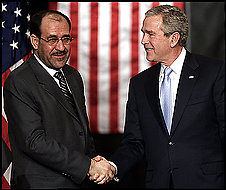
At a news conference yesterday after a summit with Iraqi Prime Minister Nouri al-Maliki in Amman, Jordan, Bush seemed to douse the idea of withdrawal in response to news reports about the Iraqi Study Group's recommendations. "This business about graceful exit just simply has no realism to it whatsoever," Bush said.
But aides later cautioned against interpreting that as opposition to any change in the U.S. troop posture. "That's not the case," said one senior official, who spoke on the condition of anonymity. "His position is he's not entering this process with defeat on his mind" for the sole purpose of getting out, the official said.
Friday, November 24, 2006
Student Study Guide Page 75 # 7
1. Copy and paste and/or Post your essay/free response to this blog before Saturday.
2. Read someone else's essay/free response and comment on the content of it.
(# 7: State whether you personally believe that all types of political groups should receive the full protection of American laws. If so, why? If not, to which groups would you deny which rights?)
2. Read someone else's essay/free response and comment on the content of it.
(# 7: State whether you personally believe that all types of political groups should receive the full protection of American laws. If so, why? If not, to which groups would you deny which rights?)
Sunday, November 12, 2006
Sunday, November 05, 2006
Analysis: How many seats will change hands in the 2006 elections?
Do you need to revise your previous predictions?
Last chance to comment on the latest polling, the "mood of the country", voters sticking with or running away from their party, final campaign swings, ad blitzes and last minute political scandals and events . . .
Last chance to comment on the latest polling, the "mood of the country", voters sticking with or running away from their party, final campaign swings, ad blitzes and last minute political scandals and events . . .
Sunday, October 22, 2006
Opinion: What should the motto of this election be? Choose one or create your own:
"Cut and Run"
"Stay the Course"
"This is a 'mood' election like 1994, and voters are in a bad mood"
"A Speaker Pelosi will try to impeach the president and hand out subpoenas daily."
"Do nothing Congress"
"Our nation will be weaker, and the enemies of our nation will be stronger"
"Scandal, scandal, scandal"
"Iraq, Iraq, Iraq"
"It's the economy, stupid"
Analysis: Will the release of this verdict focus voters on security issues and impact the election? (please try to limit conspiracy theories!)

A verdict against Saddam Hussein will be announced Nov. 5
Oct 16, 10:39 AM EDT
Brother of Saddam Prosecutor Is Killed
By QASSIM ABDUL-ZAHRA Associated Press Writer
BAGHDAD, Iraq (AP) -- The brother of the top prosecutor in the second trial of Saddam Hussein was shot dead in front of his wife at his home in the capital Monday, according to a key official charged insuring no former members of the Saddam regime hold positions of authority.
Imad al-Faroon died immediately after the shooting at his home in west Baghdad, Dr. Ali al-Lami, head of the government De-Baathification Committee, told The Associated Press.
Al-Faroon's brother is chief prosecutor Muqith al-Faroon, who is leading the Saddam prosecution on charges of crimes against humanity in his alleged killing of thousands of Kurds during the Iran-Iraq war.
A verdict against Saddam Hussein and seven co-defendants charged with crimes against humanity in connection with an anti-Shiite crackdown in the 1980s will be announced Nov. 5, a senior court official said on Monday.
Sentences for those found guilty will be issued the same day, chief investigating judge Raid Juhi told The Associated Press.
The former Iraqi leader could be hanged if convicted. However, he could appeal the sentence to a higher, nine-judge court. His co-defendants include his former deputy, Taha Yassin Ramadan, and his half-brother and former intelligence chief Barzan Ibrahim.
Analysis: What impact will campaign tactics have in the last two weeks of this election cycle?
Rove Road-Tests Tougher Attack on Democrats
By Michael Abramowitz and Zachary A. GoldfarbSunday, October 22, 2006
BUFFALO, Oct. 21 -- Republicans have been promising they would ratchet up the rhetoric against Democrats in the final two weeks of the fall campaign, and the man President Bush called "The Architect" of his political campaigns offered a preview of what they have in mind on Friday night.
Appearing in support of embattled GOP Rep. Thomas M. Reynolds (R-N.Y.), Karl Rove offered biting jibes against House Democratic leader Nancy Pelosi (Calif.), took a shot at the American Civil Liberties Union (ACLU) and asserted that Democratic policies would leave the country weaker.
"You can't say I want to win the war but not be willing to fight the war," said Rove, Bush's top political adviser. "And if leading Democrats have their way, our nation will be weaker and the enemies of our nation will be stronger. And that's a stark fact, and it's the reason that this fall election will turn very heavily on national security."
Officially, Rove was speaking at the annual dinner for the Erie County Republican Party, but in many ways, the appearance was a show of support for Reynolds, the chairman of the National Republican Campaign Committee, who is in danger this fall after questions about his role in responding to the Mark Foley page scandal.
Sen. John McCain (R-Ariz.) was supposed to be the speaker at the dinner and rally, but he canceled, pleading a scheduling conflict, the Buffalo News said. McCain did speak to the rally by telephone, praising Reynolds as "one of my heroes."
Rove stepped in at dinner and used his speech to road-test new lines of attack on the Democrats. The basic themes -- that voters face a stark choice between the parties on taxes and terrorism -- have been a Bush standard. But Rove, who once claimed liberals preferred "therapy" to war against terrorists, delivered them with an acerbity not seen from his boss.
For instance, he needled congressional Democrats for voting against a GOP plan to try terrorist suspects at the Guantanamo Bay prison in Cuba. Many Democrats said the plan violated basic rights, but Rove rejected that. "You need to have the ability to try these people without worrying about the ACLU showing up saying, 'Wait a minute, did you Mirandize them when you found them on the battlefield,' " he said. "With all due respect, I don't happen to remember that in World War II, that when we captured Nazis and Japanese and took them to camps, that the first thing we did was provide them legal aid."
He also went after the would-be House speaker for voting against renewing the USA Patriot Act, the warrantless wiretapping program and the war in Iraq. "With a record like that, you can see why Nancy Pelosi wouldn't want this election to be about national security," Rove said.
Pelosi spokesman Brendan Daly responded, "Clearly, the White House is getting desperate to keep their rubber-stamp Republican Congress."
Monday, October 09, 2006
Saturday, September 30, 2006


Analysis: Who do you think will control the House and/or Senate after the November elections?
FOXNEWS.COM HOME > POLITICS
Former Rep. Mark Foley Leaves D.C. in Hurry After E-Mail Scandal
Saturday, September 30, 2006
WASHINGTON — This time there were no tortured explanations, no heels dug in, no long, slow drip of revelation or fight for redemption.Former Rep. Mark Foley Leaves D.C. in Hurry After E-Mail Scandal
Saturday, September 30, 2006
Republican Rep. Mark Foley, of Florida, just up and quit after his e-mails expressing undue interest in a 16-year-old male page were exposed to the nation. Less than six weeks from a tough election for Republicans who control an already ethically tainted Congress, the more common stick-it-out approach to scandal was cast aside.
"Resigning leaves your attackers nowhere to go," said Eric Dezenhall, a crisis-management consultant. "If this had dragged on, it could have sucked Republicans into the vortex of scandal."
Monday, September 11, 2006
Analysis: What impact will focusing on fighting terrorism have in the midterm elections?
WASHINGTON (CNN) -- President Bush told the American people Monday night that the country faces "a struggle for civilization" as it fights the war on terrorism sparked by the 9/11 attacks five years ago.
In an address from the Oval Office, the president stressed the necessity of victory, tying together conflicts from Afghanistan to Iraq to Lebanon as a "struggle between tyranny and freedom" that rivaled World War II.
"The war against this enemy is more than a military conflict. It is the decisive ideological struggle of the 21st century and the calling of our generation," he said. "Do we have the confidence to do in the Middle East what our fathers and grandfathers accomplished in Europe and Asia?" Bush asked.
"If we do not defeat these enemies now, we will leave our children to face a Middle East overrun by terrorist states and radical dictators armed with nuclear weapons," Bush said. "We are in a war that will set the course for this new century and determine the destiny of millions across the world."
"We are fighting to maintain the way of life enjoyed by free nations, and we are fighting for the possibility that good and decent people across the Middle East can raise up societies based on freedom and tolerance and personal dignity," Bush said. "By standing with democratic leaders and reformers, by giving voice to the hopes of decent men and women, we are offering a path away from radicalism."
Friday, August 18, 2006
Opinion: Does the warrantless surveillance program violate the Bill of Rights?

By SARAH KARUSH, Associated Press Writer Fri Aug 18, 6:56 AM ET
DETROIT - A federal judge decision's to strike down
President Bush's warrantless surveillance program was the first ruling over its legality, but surely not the last.
U.S. District Judge Anna Diggs Taylor in Detroit ruled that the program violated the rights to free speech and privacy, as well as the separation of powers enshrined in the Constitution.
The administration said it would appeal to the 6th U.S. Circuit Court of Appeals in Cincinnati.
"We're going to do everything we can do in the courts to allow this program to continue," Attorney General Alberto Gonzales said at a news conference in Washington.
Taylor was the first judge to rule on the legality of the National Security Agency's program, which the White House says is a key tool for fighting terrorism that has already stopped attacks.
"Plaintiffs have prevailed, and the public interest is clear, in this matter. It is the upholding of our Constitution," Taylor wrote in her 43-page opinion.
White House press secretary Tony Snow said the Bush administration "couldn't disagree more with this ruling." He said the program carefully targets communications of suspected terrorists and "has helped stop terrorist attacks and saved American lives."
Taylor ordered an immediate halt to the program, but the government said it would ask for a stay of that order pending appeal.
The American Civil Liberties Union, which brought the suit, said it would oppose a stay but agreed to delay enforcement of the injunction until Taylor hears arguments Sept. 7.
The ACLU filed the lawsuit in January on behalf of journalists, scholars and lawyers who say the program has made it difficult for them to do their jobs. They believe many of their overseas contacts are likely targets of the program, which monitors international phone calls and e-mails to or from the U.S. involving people the government suspects have terrorist links.
The ACLU says the 1978 Foreign Intelligence Surveillance Act, which set up a secret court to grant warrants for such surveillance, gave the government enough tools to monitor suspected terrorists.
The government argued the NSA program is well within the president's authority but said proving that would require revealing state secrets. The ACLU said the state-secrets argument was irrelevant because the Bush administration already had publicly revealed enough information about the program for Taylor to rule. The administration has decried leaks that led to a New York Times report about the existence of the program last year.
Taylor, a Carter appointee, said the government appeared to argue that the program is beyond judicial scrutiny. "It was never the intent of the framers to give the president such unfettered control, particularly where his actions blatantly disregard the parameters clearly enumerated in the Bill of Rights," she wrote. "The three separate branches of government were developed as a check and balance for one another."
ACLU executive director Anthony Romero called Taylor's opinion "another nail in the coffin in the Bush administration's legal strategy in the war on terror."
While siding with the ACLU on the surveillance issue, Taylor dismissed a separate claim by the group over NSA data-mining of phone records. She said not enough had been publicly revealed about that program to support the claim and further litigation would jeopardize state secrets.
___
Associated Press writers Katherine Shrader in Washington and Jeremiah Marquez in Los Angeles contributed to this report.
Saturday, August 05, 2006
Analysis: What will the impact of fighting between Israel and Hezbollah be on U.S. politics? Will the U.S. government continue to get more involved?
Israeli commandos renew attack on Tyre
AP - Via Yahoo.com
TYRE, Lebanon - Israeli naval commandos battled with Hezbollah in the southern port city of Tyre early Saturday (8-5-06), while Israeli air raids killed at least eight people in multiple strikes across Lebanon and a Hezbollah rocket barrage killed three in northern Israel. After days of negotiations, the U.S. and France reached agreement Saturday (8-5-06) on a U.N. Security Council resolution aimed at getting a cease-fire, U.S. Ambassador John Bolton said.
Opinion: Should the estate tax be cut? Why or Why not?
GOP Bid On Wages, Estate Tax Is Blocked
Democrats Prevent Vote on Senate Bill
By Charles BabingtonWashington Post Staff WriterFriday, August 4, 2006; Page A01
Senate Democrats blocked a Republican bid to combine a tax cut for the wealthy with a wage increase for the working poor, adding a volatile economic issue to this fall's congressional campaigns.
GOP leaders fell three votes short of the 60 needed to cut off debate and bring the package to the Senate floor, where it was considered certain to pass on a simple-majority vote. Republicans said Democrats will pay a price in November, contending that most Americans support the bill's call for an increase in the minimum wage and deep cuts in the estate tax. But Democrats said rich Americans have received enough breaks from the Bush administration and the GOP-led Congress. Voters, they said, will see the Republican-backed bill as a ploy to further enrich upper-income families while trying to usurp the Democrats' role as champions of the working poor.
Under the bill, "8,100 of the wealthy and well-off hit the jackpot, while millions of working families get $800 billion in [federal] debt," said Minority Leader Harry M. Reid (D-Nev.), who led the opposition to the measure.
The official Senate tally was 56 to 42 in favor of proceeding to a vote on the wage-and-tax bill, short of the 60 required. Senate Majority Leader Bill Frist (R-Tenn.) supported the package but switched his vote -- reducing the final number to 56 from 57 -- to enable him to seek a reconsideration later. Republicans Lincoln D. Chafee (R.I.) and George V. Voinovich (Ohio) joined one independent and 38 Democrats -- including the two from Maryland -- in opposing the bill by backing the filibuster. Four Democrats and 52 Republicans -- including Virginia's two senators -- signaled their support for the bill by voting to limit debate.
Republican leaders in Congress have long wanted to eliminate or slash the taxes levied on estates left by wealthy people, but the Senate has repeatedly refused. Hoping to attract enough Democratic support, House leaders last week added a sweetener: the first increase in the federal minimum wage in nine years, plus an extension of several popular tax breaks for businesses. The House passed the complex measure -- dubbed "the trifecta" because of its three main facets -- and sent it to the Senate, which planned to vote before adjourning this weekend for the August break. Frist agreed to the deal, hoping that several Democrats could not resist a chance to raise the minimum wage, in three phases, to $7.25 an hour from the current $5.15. The bill would also have exempted from taxation all estates worth as much as $5 million -- or $10 million for a married couple -- and applied a 15 percent tax rate to inheritances above that threshold and up to $25 million. The value of estates exceeding $25 million would have been taxed at 30 percent.
Most congressional Democrats support raising the minimum wage and oppose cutting the estate tax. Most Republicans take the opposite view, although some from both parties support both proposals. Democrats said they will keep pushing to raise the minimum wage with no strings attached. GOP senators had practically dared Democrats to vote against the package with the minimum-wage increase. All but four Senate Democrats took the dare, heeding Reid's plea to deny Frist a victory as lawmakers go home to campaign. Republicans predicted that Democrats will regret their decision.
"I certainly wouldn't want to vote against this bill" and then face the voters, Sen. John E. Sununu (R-N.H.) said in an interview. Polls show overwhelming public support for raising the minimum wage and for eliminating "the death tax," he said. Voting against the package, he said, "is bad for the country, and bad politics, too." Sen. Mitch McConnell (R-Ky.) said all three elements of the bill could have survived simple-majority votes had they been allowed, and he accused the Democrats of being obstructionists. "How can we have bipartisanship in the Congress if Democrats won't take 'yes' for an answer?" he asked.
But Democrats expressed confidence that voters will see the package as a cynical effort to help wealthy GOP supporters by making the estate tax cut the price for a wage increase that the nation's lowest-paid workers deserve.
Democrats Prevent Vote on Senate Bill
By Charles BabingtonWashington Post Staff WriterFriday, August 4, 2006; Page A01
Senate Democrats blocked a Republican bid to combine a tax cut for the wealthy with a wage increase for the working poor, adding a volatile economic issue to this fall's congressional campaigns.
GOP leaders fell three votes short of the 60 needed to cut off debate and bring the package to the Senate floor, where it was considered certain to pass on a simple-majority vote. Republicans said Democrats will pay a price in November, contending that most Americans support the bill's call for an increase in the minimum wage and deep cuts in the estate tax. But Democrats said rich Americans have received enough breaks from the Bush administration and the GOP-led Congress. Voters, they said, will see the Republican-backed bill as a ploy to further enrich upper-income families while trying to usurp the Democrats' role as champions of the working poor.

Under the bill, "8,100 of the wealthy and well-off hit the jackpot, while millions of working families get $800 billion in [federal] debt," said Minority Leader Harry M. Reid (D-Nev.), who led the opposition to the measure.
The official Senate tally was 56 to 42 in favor of proceeding to a vote on the wage-and-tax bill, short of the 60 required. Senate Majority Leader Bill Frist (R-Tenn.) supported the package but switched his vote -- reducing the final number to 56 from 57 -- to enable him to seek a reconsideration later. Republicans Lincoln D. Chafee (R.I.) and George V. Voinovich (Ohio) joined one independent and 38 Democrats -- including the two from Maryland -- in opposing the bill by backing the filibuster. Four Democrats and 52 Republicans -- including Virginia's two senators -- signaled their support for the bill by voting to limit debate.
Republican leaders in Congress have long wanted to eliminate or slash the taxes levied on estates left by wealthy people, but the Senate has repeatedly refused. Hoping to attract enough Democratic support, House leaders last week added a sweetener: the first increase in the federal minimum wage in nine years, plus an extension of several popular tax breaks for businesses. The House passed the complex measure -- dubbed "the trifecta" because of its three main facets -- and sent it to the Senate, which planned to vote before adjourning this weekend for the August break. Frist agreed to the deal, hoping that several Democrats could not resist a chance to raise the minimum wage, in three phases, to $7.25 an hour from the current $5.15. The bill would also have exempted from taxation all estates worth as much as $5 million -- or $10 million for a married couple -- and applied a 15 percent tax rate to inheritances above that threshold and up to $25 million. The value of estates exceeding $25 million would have been taxed at 30 percent.
Most congressional Democrats support raising the minimum wage and oppose cutting the estate tax. Most Republicans take the opposite view, although some from both parties support both proposals. Democrats said they will keep pushing to raise the minimum wage with no strings attached. GOP senators had practically dared Democrats to vote against the package with the minimum-wage increase. All but four Senate Democrats took the dare, heeding Reid's plea to deny Frist a victory as lawmakers go home to campaign. Republicans predicted that Democrats will regret their decision.
"I certainly wouldn't want to vote against this bill" and then face the voters, Sen. John E. Sununu (R-N.H.) said in an interview. Polls show overwhelming public support for raising the minimum wage and for eliminating "the death tax," he said. Voting against the package, he said, "is bad for the country, and bad politics, too." Sen. Mitch McConnell (R-Ky.) said all three elements of the bill could have survived simple-majority votes had they been allowed, and he accused the Democrats of being obstructionists. "How can we have bipartisanship in the Congress if Democrats won't take 'yes' for an answer?" he asked.
But Democrats expressed confidence that voters will see the package as a cynical effort to help wealthy GOP supporters by making the estate tax cut the price for a wage increase that the nation's lowest-paid workers deserve.
Monday, July 24, 2006
Opinion: Should someone's gender be considered when voters decide who to vote for in the next presidential election?

In a recent CNN story about the Draft Condi movement, Condoleeza Rice was described as the "most popular current public official in the country." Yet she hasn't taken stances on many important issues which makes some conservatives wonder if she would be a good Republican candidate. Hillary Rodham Clinton is seen as a front runner in the Democratic primaries. Yet she has been careful not to come out too strongly against the Iraq war (a position at odds with many Democrats). Are these possible candidates for president bolstered by their gender? Should someone's gender be considered an attribute (positive or negative)? Would you vote for a candidate mainly because she's a woman, or does she have to match your political philsophy as well?

(incidentally, Dick Morris and Eileen McGann have written a book about this potential matchup. I haven't read it yet, but I hear that "Condi vs. Hillary: The Next Great Presidential Race" is a pretty good book.)
Wednesday, June 21, 2006
Opinion: Should competition in the marketplace determine wages, or should the current minimum wage be increased through legislation?
Senate nixes bid to raise minimum wage
WASHINGTON (AP) -- The Republican-controlled Senate smothered a proposed election-year increase in the minimum wage Wednesday, rejecting Democratic claims that it was past time to boost the $5.15 hourly pay floor that has been in effect for nearly a decade.
Wednesday, June 21, 2006; Posted: 6:15 p.m. EDT (22:15 GMT) WASHINGTON (AP) -- The Republican-controlled Senate smothered a proposed election-year increase in the minimum wage Wednesday, rejecting Democratic claims that it was past time to boost the $5.15 hourly pay floor that has been in effect for nearly a decade.
The 52-46 vote was eight short of the 60 needed for approval and came one day after House Republican leaders made clear they do not intend to allow a vote on the issue, fearing it might pass.
Sixty votes were required because the plan was proposed as an amendment to an unrelated defense bill.
The Senate vote marked the ninth time since 1997 that Democrats there have proposed -- and Republicans have blocked -- a stand-alone increase in the minimum wage. The debate fell along predictable lines.

"Americans believe that no one who works hard for a living should have to live in poverty. A job should lift you out of poverty, not keep you in it," said Sen. Edward M. Kennedy, D-Massachusetts (pictured at right). He said a worker paid $5.15 an hour would earn $10,700 a year, "almost $6,000 below the poverty line for a family of three."
Republicans said a minimum wage increase would wind up hurting the low-wage workers that Democrats said they want to help.
"For every increase you make in the minimum wage, you will cost some of them their jobs," said Sen. Johnny Isakson, R-Georgia.
He described the clash as a "classic debate between two very different philosophies. One philosophy that believes in the marketplace, the competitive system ... and entrepreneurship. And secondly is the argument that says the government knows better and that topdown mandates work."
The measure drew the support of 43 Democrats, eight Republicans and one independent. Four of those eight Republicans are seeking re-election in the fall.
Democrats had conceded in advance that this attempt to raise the minimum wage would fare no better than their previous attempts. At the same time, they have made clear in recent days they hope to gain support in the coming midterm elections by stressing the issue. Organized labor supports the legislation, and Sen. Chris Dodd, D-Connecticut, said that contrary to some impressions, most minimum wage workers are adults, not teenagers, and many of them are women.
"When the Democrats control the Senate, one of the first pieces of legislation we'll see is an increase in the minimum wage," said Kennedy.
His proposal would have increased the minimum wage to $5.85 beginning 60 days after the legislation was enacted; to $6.55 one year later; and to $7.25 a year after that. He said inflation has eroded the value of the current $5.15 minimum wage by 20 percent.
With the help of a few rebellious Republicans, House Democrats on the House Appropriations Committee succeeded in attaching a minimum wage increase last week to legislation providing funding for federal social programs. Fearing that the House would pass the measure with the increase intact, the GOP leadership swiftly decided to sidetrack the entire bill.
"I am opposed to it, and I think a vast majority of our (rank and file) is opposed to it," House Majority Leader John Boehner, R-Ohio, said Tuesday. Pressed by reporters, he said, "There are limits to my willingness to just throw anything out on the floor."
While Democrats depend on organized labor to win elections, Republicans are closely aligned with business interests that oppose any increase in the federal wage floor or would like changes in the current system.
Sen. Mike Enzi, R-Wyoming, chairman of the Senate Health, Education, Labor and Pensions Committee, offered an alternative that proposed a minimum wage increase of $1.10 over 18 months, in two steps. The increase was coupled with a variety of provisions offering regulatory or tax relief to small businesses, including one to exempt enterprises with less than $1 million in annual receipts from the federal wage and hour law entirely. The current exemption level is $500,000, and a Republican document noted the amount had "lagged behind inflation."
Additionally, Republicans proposed a system of optional "flextime" for workers, a step that Enzi said would allow employees, at their discretion, to work more than 40 hours one week in exchange for more time off the next. Unions generally oppose such initiatives, and the Republican plan drew 45 votes, with 53 in opposition.
Nine Senate Republicans voted against both proposals.
Copyright 2006 The Associated Press. All rights reserved.
Subscribe to:
Posts (Atom)