As the World Warms, the White House Aspires
By Dana MilbankFriday, June 1, 2007 (from WashingtonPost.com)
Yesterday, as the temperature pushed toward 90 degrees in the capital, global warming caused a meltdown in the Bush administration's message machine.
Just as President Bush was about to wheel out his "new international climate change framework," the NASA administrator, Michael Griffin, declared that there is no need to take action against global warming.
"Whether that is a long-term concern or not, I can't say," he said in an interview with National Public Radio, adding: "I am not sure that it is fair to say that it is a problem we must wrestle with." In fact, Griffin found it "rather arrogant" to suggest that global warming is a bad thing.
A couple of hours after the broadcast, Griffin's boss took the stage at the Ronald Reagan Building to endorse just such arrogance -- an initiative aimed at reducing greenhouse gases. "The United States takes this issue seriously," Bush said.
This mixed message led to a rather cool reception for Jim Connaughton, the president's adviser on the environment, as he briefed reporters on the plan at noon.
"Will the new framework consist of binding commitments or voluntary commitments?" asked CBS News's Jim Axelrod.
"In this instance, you have a long-term, aspirational goal," Connaughton answered.
Aspirational goal? Like having the body you want without diet or exercise? Or getting rich without working?
"I'm confused," Axelrod said. "Does that mean there will be targets for greenhouse gas emission reductions, and that everybody will be making binding commitments?"
"The commitment at the international level will be to a long-term, aspirational goal," the Bush aide repeated.
Axelrod had his answer. "Voluntary," he concluded.
"Well," said Connaughton, "I want to be careful about the word 'voluntary.' "
Sunday, June 03, 2007

Saturday, May 26, 2007
Opinion: If, like MHS grad Elliott Anderson, you were delivering a Memorial Day address, what would you say to the nation?
Bush pays tribute to fallen U.S. troops
By DEB RIECHMANN, Associated Press
President Bush urged Americans to use Memorial Day to rededicate themselves to fighting for freedom around the world and pray for the safety of U.S. troops serving overseas.
"In Iraq and Afghanistan, millions have shown their desire to be free," Bush said Saturday in his weekly radio address. "We are determined to help them secure their liberty. "
On Monday, Bush will mark his sixth Memorial Day as a wartime president with a visit to Arlington National Cemetery. He is to lay a wreath at the Tomb of the Unknowns to honor those who have died in past and current conflicts.
"From Valley Forge to Vietnam, from Kuwait to Kandahar, from Berlin to Baghdad, brave men and women have given up their own futures so that others might have a future of freedom," he said. "Because of their sacrifice, millions here and around the world enjoy the blessings of liberty. And wherever these patriots rest, we offer them the respect and gratitude of our nation."
Bush used his radio address to tell the story of Sgt. David Christoff Jr. of Rossford, Ohio, one of at least 3,431 members of the U.S. military who have died since the beginning of the Iraq war in March 2003. Christoff signed up for the Marines the day after the Sept. 11 attacks in 2001, saying he didn't want his brother and sister to "live in fear," Bush said.
Christoff was deployed to Iraq, where he fought in street battles in Fallujah and earned a Purple Heart for wounds suffered in action. He returned to Iraq and was killed last May in the volatile Anbar province.
"When his family received his belongings, his mother and his father each found a letter from David," Bush said. "He asked that they pray for his fellow Marines and all those still serving overseas."
Bush said U.S. troops are helping build democracies that respect the rights of their people, uphold the rule of law and become allies in the fight against extremists.
"On Memorial Day, we rededicate ourselves to freedom's cause," the president said.
For their weekly radio address, Democrats called on Elliot Anderson of Las Vegas, who spent four years on active duty with the Marine Corps, including a seven-month deployment to Afghanistan.
Anderson said patriotism is an American value, not a Democratic or a Republican one.
"I strongly oppose our involvement in Iraq's civil war, but I am still proud of my service to my country," Anderson said.
"But I know I speak for many of my friends overseas when I say that the best way to honor the troops is to responsibly end our involvement in Iraq's civil war. As long as President Bush stays committed to the same policies that aren't working, it won't be easy. But I am proud to see Democrats and now some brave Republicans standing up to him."
By DEB RIECHMANN, Associated Press
President Bush urged Americans to use Memorial Day to rededicate themselves to fighting for freedom around the world and pray for the safety of U.S. troops serving overseas.
"In Iraq and Afghanistan, millions have shown their desire to be free," Bush said Saturday in his weekly radio address. "We are determined to help them secure their liberty. "
On Monday, Bush will mark his sixth Memorial Day as a wartime president with a visit to Arlington National Cemetery. He is to lay a wreath at the Tomb of the Unknowns to honor those who have died in past and current conflicts.
"From Valley Forge to Vietnam, from Kuwait to Kandahar, from Berlin to Baghdad, brave men and women have given up their own futures so that others might have a future of freedom," he said. "Because of their sacrifice, millions here and around the world enjoy the blessings of liberty. And wherever these patriots rest, we offer them the respect and gratitude of our nation."
Bush used his radio address to tell the story of Sgt. David Christoff Jr. of Rossford, Ohio, one of at least 3,431 members of the U.S. military who have died since the beginning of the Iraq war in March 2003. Christoff signed up for the Marines the day after the Sept. 11 attacks in 2001, saying he didn't want his brother and sister to "live in fear," Bush said.
Christoff was deployed to Iraq, where he fought in street battles in Fallujah and earned a Purple Heart for wounds suffered in action. He returned to Iraq and was killed last May in the volatile Anbar province.
"When his family received his belongings, his mother and his father each found a letter from David," Bush said. "He asked that they pray for his fellow Marines and all those still serving overseas."
Bush said U.S. troops are helping build democracies that respect the rights of their people, uphold the rule of law and become allies in the fight against extremists.
"On Memorial Day, we rededicate ourselves to freedom's cause," the president said.
For their weekly radio address, Democrats called on Elliot Anderson of Las Vegas, who spent four years on active duty with the Marine Corps, including a seven-month deployment to Afghanistan.
Anderson said patriotism is an American value, not a Democratic or a Republican one.
"I strongly oppose our involvement in Iraq's civil war, but I am still proud of my service to my country," Anderson said.
"But I know I speak for many of my friends overseas when I say that the best way to honor the troops is to responsibly end our involvement in Iraq's civil war. As long as President Bush stays committed to the same policies that aren't working, it won't be easy. But I am proud to see Democrats and now some brave Republicans standing up to him."
Thursday, April 26, 2007
Who won the Democratic debate?
(see the Republicans debate next Thursday, May 3 on MSNBC)
My comments
Clinton: Held her own as a front runner. Didn't sound angry. Mentioned finding bin Laden. Mentioned "the Clinton Administration" when appropriate. Sounded presidential?
Obama: Disappointing? Not as good as he is on the stump? He answered two questions really well (the first when Williams asked him a tough follow-up question). He shouldn't have gotten into it with Kucinich. Has he come down to the level of the other candidates because of this debate? Or is his level so high right now that if he doesn't juggle fire it's a let down?
Gravel: Wow.
Biden: Best answer of the entire debate: "Yes." Paraphrasing: he answered the question of whether he could assure the American people that he wouldn't be too verbose on the world stage. I clapped for that answer!
Gravel: Again, wow. Somebody afterward said he stole Kucinich's thunder.
Kucinich: He's probably right on a lot, but he won't be president or vice-president. How is that possible? The same reason communism doesn't work? Great theory, but the reality is. . .
My comments
Clinton: Held her own as a front runner. Didn't sound angry. Mentioned finding bin Laden. Mentioned "the Clinton Administration" when appropriate. Sounded presidential?
Obama: Disappointing? Not as good as he is on the stump? He answered two questions really well (the first when Williams asked him a tough follow-up question). He shouldn't have gotten into it with Kucinich. Has he come down to the level of the other candidates because of this debate? Or is his level so high right now that if he doesn't juggle fire it's a let down?
Gravel: Wow.
Biden: Best answer of the entire debate: "Yes." Paraphrasing: he answered the question of whether he could assure the American people that he wouldn't be too verbose on the world stage. I clapped for that answer!
Gravel: Again, wow. Somebody afterward said he stole Kucinich's thunder.
Kucinich: He's probably right on a lot, but he won't be president or vice-president. How is that possible? The same reason communism doesn't work? Great theory, but the reality is. . .
Monday, April 16, 2007
FEC Filings:
Primary Money Raised this quarter:
Obama: $24.8 million
Clinton: $19.1 million
Richardson: $6.2 million
Giuliani: about $12 million on hand
Romney: about $12 million on hand
McCain: $5.2 million on hand
Edwards: $10 million on hand
More info:
"But Clinton established a solid overall financial advantage by transferring $10 million from her Senate campaign account and limiting her spending -- in part by carrying $1.6 million in debt, including money she owes to several key advisers. She also raised $7 million that can be spent only if she becomes the nominee." WashingtonPost.com
Obama: $24.8 million
Clinton: $19.1 million
Richardson: $6.2 million
Giuliani: about $12 million on hand
Romney: about $12 million on hand
McCain: $5.2 million on hand
Edwards: $10 million on hand
More info:
"But Clinton established a solid overall financial advantage by transferring $10 million from her Senate campaign account and limiting her spending -- in part by carrying $1.6 million in debt, including money she owes to several key advisers. She also raised $7 million that can be spent only if she becomes the nominee." WashingtonPost.com
Sunday, April 15, 2007
For those that are interested:
I saw this on C-SPAN this morning and went to his website to confirm it. (None of the other candidates, Republican or Democratic are in Wisconsin this coming week.)
Please join Milwaukee in Welcoming
Senator Barack Obama
To his Wisconsin Kick-Off Event
Benefiting Obama for America
April 16, 2007
Doors Open at 6:00PM
The Milwaukee Theater
500 West Kilbourn Avenue
Milwaukee, WI 53203
Please join Milwaukee in Welcoming
Senator Barack Obama
To his Wisconsin Kick-Off Event
Benefiting Obama for America
April 16, 2007
Doors Open at 6:00PM
The Milwaukee Theater
500 West Kilbourn Avenue
Milwaukee, WI 53203
Friday, April 06, 2007
Study Review Prepare
No Blog posts are necessary until the week of April 16-22. Use this time to begin studying, reviewing, and preparing. Also, write your media essay. Check back here every couple days for tools to aid your studying.
Sunday, April 01, 2007
Opinion: Does money matter? Should money matter?
WASHINGTON - Two Democratic presidential candidates broke previous fundraising records during the first three months of the year, with Sen. Hillary Rodham Clinton setting a high bar of $26 million in new contributions for the quarter. Former Sen. John Edwards raised more than $14 million since the beginning of the year. Clinton also transferred $10 million from her Senate campaign account, bringing her total receipts for the quarter to $36 million.
Unlike Edwards, Clinton aides would not reveal how much of her total was available only for the primary election and how much could be used just in the general election, if she were the party's nominee. By not breaking down the amount available for the primaries, the Clinton camp made it impossible to assess how much of an edge she actually has over Edwards.
Edwards' aides said about $1 million of his $14 million in contributions could only be used in the general election, should he win the nomination. Neither Clinton nor Edwards disclosed how much money they spent in the quarter or how much cash they had in hand — numbers that also give clues to the relative strengths of the campaigns. Still, the total raised by each candidate outdistanced past presidential election records and set a new bar by which to measure fundraising abilities.
Sen. Barack Obama of Illinois, sandwiched in public opinion polls between Clinton and Edwards, had yet to reveal his totals.
New Mexico Gov. Bill Richardson's campaign said he had raised $6 million in primary campaign money and had more than $5 million cash in hand at the end of the three-month period. Aides to Sen. Chris Dodd, D-Conn., said he raised more than $4 million in the quarter, transferred nearly $5 million from his Senate campaign account and had $7.5 million cash on hand. Sen. Joseph Biden, D-Del., said on "Fox News Sunday" he had raised about $3 million in the quarter. Biden also had about $3.6 million in his Senate campaign account that he could transfer to a presidential run.
The rest of the Democratic field and the Republican presidential candidates planned to announce their first-quarter totals over the next few days. The fundraising deadline for the January through March period was Saturday, with financial reports due April 15.
Republican Phil Gramm of Texas and Democrat Al Gore of Tennessee held the records for first-quarter receipts: $8.7 million for Gramm in 1995 and $8.9 million for Gore in 1999. Gramm dropped out before New Hampshire held the 1996 election's first primary.
"We are completely overwhelmed and gratified by the historic support that we've gotten this quarter," Clinton campaign manager Patti Solis Doyle said. The Clinton total included $4.2 million raised through the Internet, typically a source of small donations.
By not breaking down the amount available for the primaries, the Clinton camp made it impossible to make clear comparisons to past campaigns or to the Edwards total. "We're above our budget for the year," Edwards deputy campaign manager Jonathan Prince said. "We're completely on track to have all the money that we need to be highly competitive in the campaign."
Most of the top tier candidates in the Republican and Democratic fields for 2008 are raising money for the primaries and the general election. The general election money can only be spent if the candidate wins the nomination.
Obama also has raised money aggressively and aides said he had more than 83,000 donors. Clinton's supporters had fretted in recent weeks that Obama could surpass her in fundraising.
Obama, in an interview with The Associated Press on Sunday, was coy.
"I think we'll do well," Obama said. "I think that we should meet people's expectations. More importantly, I think we will have raised enough money to make sure we can compete for the next quarter and beyond. I think we'll do pretty well."
Edwards reported raising more than $3 million on the Internet and easily passed the $7.4 million first-quarter fundraising mark he set in his 2003-04 presidential campaign. No Republican presidential candidates had released fundraising totals Sunday. For the first time since the post-Watergate era changes to campaign finance laws, candidates are considering bypassing the public financing system for the presidential primaries and the general election. Several of the top candidates are raising both primary and general election money, artificially inflating their receipts.
Candidates cannot touch their general election money and must return it to donors if they do not win the nomination.
The Federal Election Commission ruled recently that candidates could also collect general election money now and still accept public financing later, provided they returned the money they raised. The opinion came at the request of Obama, who then said he would finance his general election campaign if his Republican rival did as well. Sen. John McCain, R-Ariz., issued a similar challenge.
The first-quarter totals are one gauge of a campaign's strength. Compared with previous elections, attention to fundraising during the first three months of this year has been especially acute because the leading candidates have decided to forgo public financing for the primaries.
Unlike Edwards, Clinton aides would not reveal how much of her total was available only for the primary election and how much could be used just in the general election, if she were the party's nominee. By not breaking down the amount available for the primaries, the Clinton camp made it impossible to assess how much of an edge she actually has over Edwards.
Edwards' aides said about $1 million of his $14 million in contributions could only be used in the general election, should he win the nomination. Neither Clinton nor Edwards disclosed how much money they spent in the quarter or how much cash they had in hand — numbers that also give clues to the relative strengths of the campaigns. Still, the total raised by each candidate outdistanced past presidential election records and set a new bar by which to measure fundraising abilities.
Sen. Barack Obama of Illinois, sandwiched in public opinion polls between Clinton and Edwards, had yet to reveal his totals.
New Mexico Gov. Bill Richardson's campaign said he had raised $6 million in primary campaign money and had more than $5 million cash in hand at the end of the three-month period. Aides to Sen. Chris Dodd, D-Conn., said he raised more than $4 million in the quarter, transferred nearly $5 million from his Senate campaign account and had $7.5 million cash on hand. Sen. Joseph Biden, D-Del., said on "Fox News Sunday" he had raised about $3 million in the quarter. Biden also had about $3.6 million in his Senate campaign account that he could transfer to a presidential run.
The rest of the Democratic field and the Republican presidential candidates planned to announce their first-quarter totals over the next few days. The fundraising deadline for the January through March period was Saturday, with financial reports due April 15.
Republican Phil Gramm of Texas and Democrat Al Gore of Tennessee held the records for first-quarter receipts: $8.7 million for Gramm in 1995 and $8.9 million for Gore in 1999. Gramm dropped out before New Hampshire held the 1996 election's first primary.
"We are completely overwhelmed and gratified by the historic support that we've gotten this quarter," Clinton campaign manager Patti Solis Doyle said. The Clinton total included $4.2 million raised through the Internet, typically a source of small donations.
By not breaking down the amount available for the primaries, the Clinton camp made it impossible to make clear comparisons to past campaigns or to the Edwards total. "We're above our budget for the year," Edwards deputy campaign manager Jonathan Prince said. "We're completely on track to have all the money that we need to be highly competitive in the campaign."
Most of the top tier candidates in the Republican and Democratic fields for 2008 are raising money for the primaries and the general election. The general election money can only be spent if the candidate wins the nomination.
Obama also has raised money aggressively and aides said he had more than 83,000 donors. Clinton's supporters had fretted in recent weeks that Obama could surpass her in fundraising.
Obama, in an interview with The Associated Press on Sunday, was coy.
"I think we'll do well," Obama said. "I think that we should meet people's expectations. More importantly, I think we will have raised enough money to make sure we can compete for the next quarter and beyond. I think we'll do pretty well."
Edwards reported raising more than $3 million on the Internet and easily passed the $7.4 million first-quarter fundraising mark he set in his 2003-04 presidential campaign. No Republican presidential candidates had released fundraising totals Sunday. For the first time since the post-Watergate era changes to campaign finance laws, candidates are considering bypassing the public financing system for the presidential primaries and the general election. Several of the top candidates are raising both primary and general election money, artificially inflating their receipts.
Candidates cannot touch their general election money and must return it to donors if they do not win the nomination.
The Federal Election Commission ruled recently that candidates could also collect general election money now and still accept public financing later, provided they returned the money they raised. The opinion came at the request of Obama, who then said he would finance his general election campaign if his Republican rival did as well. Sen. John McCain, R-Ariz., issued a similar challenge.
The first-quarter totals are one gauge of a campaign's strength. Compared with previous elections, attention to fundraising during the first three months of this year has been especially acute because the leading candidates have decided to forgo public financing for the primaries.
Sunday, March 18, 2007
Analysis: Will age and health concerns affect Sen. McCain's race for the White House?
WASHINGTON - John McCain (news, bio, voting record), 70 and scarred, cannot deny his age. So he jokes about it. "I'm older than dirt, more scars than Frankenstein, but I learned a few things along the way," quips the Republican presidential candidate, who tries to play down the ravages of time for the wisdom acquired over seven decades.
His body is battered from torture in Vietnam. The scar along his left cheek is a reminder of a different battle, with skin cancer. Yet, McCain packs his work days so tight that aides grouse. And the man who could be the oldest first-term president hiked the Grand Canyon from "rim to rim" last summer.
Despite McCain's high-energy lifestyle, getting older begets questions about health. The four-term Arizona senator no doubt will have to prove to voters that he is physically and mentally up to the demanding job of president. For now, the issues are only background murmurs in the 2008 race for the GOP nomination. Neither Rudy Giuliani, the 62-year-old former New York City mayor who also is a cancer survivor, nor former Massachusetts Gov. Mitt Romney, a diet-and-exercise fanatic who just turned 60, has mentioned them publicly. Still, an aging candidate troubles some voters.
Two recent surveys found that people are less likely to vote for a presidential candidate who is older than 72 than they would a candidate who has been divorced twice and a candidate who is Mormon. Giuliani is on his third marriage; Romney is a member of the Church of Jesus Christ of Latter-day Saints. In Michigan, Jerry Roe, a Republican who is a former state GOP executive director, backed McCain in 2000 but supports Romney this time. "McCain's too old," said Roe, whose son is a deputy campaign manager for Romney. "He looks tired. He looks like he's dragging," added Chip Felkel, a GOP strategist in South Carolina who says he is not aligned with a candidate.
McCain is determined to counter the notion that his age and health are hurdles, and he does not hide his distaste for the topic when questioned. "I work seven days a week, 16-plus hours a day. I'm fine. I'm in great health," McCain tells anyone who asks. To drive home the point, he talks about his Grand Canyon hike and notes that his spunky 95-year-old mother still drives and recently traveled through Europe. He does not mention that his father died in 1981 of heart failure at 70.
Campaigning, McCain seeks to counter skeptics who question his vigor. On the first day of a two-day Iowa bus tour, he talked nonstop for hours to reporters traveling with him. He met with Iowa legislators. He hosted two question-and-answer sessions with hundreds of Iowans. He held several news conferences. "He wears me out. I can't keep up with him," said his wife, Cindy, 52. Still, despite McCain's best efforts, he cannot seem to escape the age questions.
"You had a birthday," late-night comedian David Letterman mentioned last month. "Tragically," McCain said dryly.
Physically, McCain's body has withstood more trauma than those of most people his age. As a Navy pilot in Vietnam, McCain broke both arms and severely injured his right knee when his fighter jet went down in Hanoi in 1967. When his captors tended to his injuries, they did so intermittently and never properly set his broken bones. They also exacerbated McCain's wounds when they tortured him during his 5 1/2 years in prison. The results still show today. His hurried gait masks a slight limp. His oft-clenched fists hide the limited use of his arms. Arthritis has set in; he cannot raise either arm above his head. More recently, McCain had three bouts of melanoma, the most aggressive form of skin cancer. His aides say he has been cancer-free for at least five years. Still, because of his previous bouts, he is at a higher risk for a reoccurrence, as are all cancer survivors. Hundreds of health records made available during McCain's first presidential run in 2000 consistently gave him a clean bill of mental health despite long periods in solitary confinement in Vietnam. He continues to be inquisitive and quick-witted judging by his exchanges on Capitol Hill with colleagues. "He's as alert as he was 18 years ago when I went to work for him. He's as healthy as a horse," said Mark Salter, a longtime aide.
The campaign plans to release his updated health records to prove it. Aides are confident that voters will see it for themselves as the senator steps up his campaigning. Regardless of his current fitness, nobody knows how McCain would fare during his years in the Oval Office given his age and medical history. If he were nominated, his age would make his selection of a running mate even more critical. Physicians unaffiliated with him say as people get into their 70s they face the increased risk of mental impairment, ranging from mild memory loss that doesn't affect judgment to full-blown dementia that inhibits a person's ability to function in daily life. They also have a higher chance of chronic physical ailments such as high blood pressure, diabetes, arthritis and cancer. "If there is not clear evidence of serious progressive medical disabilities or cognitive impairment, I think age should not at all disqualify someone from being a candidate," said Dr. Eric De Jonge, chief of geriatrics at Washington Hospital Center.
Now 83, Bob Dole recently said McCain will face "constant questions about his fitness and ability to serve." The former Senate majority leader speaks from experience. Dole had suffered war wounds and was a cancer survivor when, at 73, he ran for the White House as the 1996 Republican presidential nominee challenging the then 50-year-old President Clinton. A dozen years earlier, Ronald Reagan — who was 69 when he was first elected and 73 during his re-election race — neutralized the question of whether he may be too old for the job. In a debate with the 56-year-old Democrat Walter Mondale, a former vice president and senator, Reagan deftly quipped: "I am not going to exploit for political purposes my opponent's youth and inexperience." Reagan was diagnosed with Alzheimer's disease just six years after leaving office.
For McCain, Republican strategists say, a release of health records as well as his appearance while campaigning will be the keys to deflecting suggestions that he may not be fit to serve. "McCain has as much energy as he did six years ago and possibly more," said Scott Reed, a Republican consultant who ran Dole's campaign. But, he said, "The campaign will have to pace him properly to make sure he's not run down, doing too many events and looking tired because the camera doesn't lie."
His body is battered from torture in Vietnam. The scar along his left cheek is a reminder of a different battle, with skin cancer. Yet, McCain packs his work days so tight that aides grouse. And the man who could be the oldest first-term president hiked the Grand Canyon from "rim to rim" last summer.
Despite McCain's high-energy lifestyle, getting older begets questions about health. The four-term Arizona senator no doubt will have to prove to voters that he is physically and mentally up to the demanding job of president. For now, the issues are only background murmurs in the 2008 race for the GOP nomination. Neither Rudy Giuliani, the 62-year-old former New York City mayor who also is a cancer survivor, nor former Massachusetts Gov. Mitt Romney, a diet-and-exercise fanatic who just turned 60, has mentioned them publicly. Still, an aging candidate troubles some voters.
Two recent surveys found that people are less likely to vote for a presidential candidate who is older than 72 than they would a candidate who has been divorced twice and a candidate who is Mormon. Giuliani is on his third marriage; Romney is a member of the Church of Jesus Christ of Latter-day Saints. In Michigan, Jerry Roe, a Republican who is a former state GOP executive director, backed McCain in 2000 but supports Romney this time. "McCain's too old," said Roe, whose son is a deputy campaign manager for Romney. "He looks tired. He looks like he's dragging," added Chip Felkel, a GOP strategist in South Carolina who says he is not aligned with a candidate.
McCain is determined to counter the notion that his age and health are hurdles, and he does not hide his distaste for the topic when questioned. "I work seven days a week, 16-plus hours a day. I'm fine. I'm in great health," McCain tells anyone who asks. To drive home the point, he talks about his Grand Canyon hike and notes that his spunky 95-year-old mother still drives and recently traveled through Europe. He does not mention that his father died in 1981 of heart failure at 70.
Campaigning, McCain seeks to counter skeptics who question his vigor. On the first day of a two-day Iowa bus tour, he talked nonstop for hours to reporters traveling with him. He met with Iowa legislators. He hosted two question-and-answer sessions with hundreds of Iowans. He held several news conferences. "He wears me out. I can't keep up with him," said his wife, Cindy, 52. Still, despite McCain's best efforts, he cannot seem to escape the age questions.
"You had a birthday," late-night comedian David Letterman mentioned last month. "Tragically," McCain said dryly.
Physically, McCain's body has withstood more trauma than those of most people his age. As a Navy pilot in Vietnam, McCain broke both arms and severely injured his right knee when his fighter jet went down in Hanoi in 1967. When his captors tended to his injuries, they did so intermittently and never properly set his broken bones. They also exacerbated McCain's wounds when they tortured him during his 5 1/2 years in prison. The results still show today. His hurried gait masks a slight limp. His oft-clenched fists hide the limited use of his arms. Arthritis has set in; he cannot raise either arm above his head. More recently, McCain had three bouts of melanoma, the most aggressive form of skin cancer. His aides say he has been cancer-free for at least five years. Still, because of his previous bouts, he is at a higher risk for a reoccurrence, as are all cancer survivors. Hundreds of health records made available during McCain's first presidential run in 2000 consistently gave him a clean bill of mental health despite long periods in solitary confinement in Vietnam. He continues to be inquisitive and quick-witted judging by his exchanges on Capitol Hill with colleagues. "He's as alert as he was 18 years ago when I went to work for him. He's as healthy as a horse," said Mark Salter, a longtime aide.
The campaign plans to release his updated health records to prove it. Aides are confident that voters will see it for themselves as the senator steps up his campaigning. Regardless of his current fitness, nobody knows how McCain would fare during his years in the Oval Office given his age and medical history. If he were nominated, his age would make his selection of a running mate even more critical. Physicians unaffiliated with him say as people get into their 70s they face the increased risk of mental impairment, ranging from mild memory loss that doesn't affect judgment to full-blown dementia that inhibits a person's ability to function in daily life. They also have a higher chance of chronic physical ailments such as high blood pressure, diabetes, arthritis and cancer. "If there is not clear evidence of serious progressive medical disabilities or cognitive impairment, I think age should not at all disqualify someone from being a candidate," said Dr. Eric De Jonge, chief of geriatrics at Washington Hospital Center.
Now 83, Bob Dole recently said McCain will face "constant questions about his fitness and ability to serve." The former Senate majority leader speaks from experience. Dole had suffered war wounds and was a cancer survivor when, at 73, he ran for the White House as the 1996 Republican presidential nominee challenging the then 50-year-old President Clinton. A dozen years earlier, Ronald Reagan — who was 69 when he was first elected and 73 during his re-election race — neutralized the question of whether he may be too old for the job. In a debate with the 56-year-old Democrat Walter Mondale, a former vice president and senator, Reagan deftly quipped: "I am not going to exploit for political purposes my opponent's youth and inexperience." Reagan was diagnosed with Alzheimer's disease just six years after leaving office.
For McCain, Republican strategists say, a release of health records as well as his appearance while campaigning will be the keys to deflecting suggestions that he may not be fit to serve. "McCain has as much energy as he did six years ago and possibly more," said Scott Reed, a Republican consultant who ran Dole's campaign. But, he said, "The campaign will have to pace him properly to make sure he's not run down, doing too many events and looking tired because the camera doesn't lie."
Sunday, March 11, 2007
Analysis: Some have mentioned that people need to be made aware of some political issues. What specifically?
 Just so I can let you know, I think people should be "made aware of" the fact that in about an hour the POLY Squad organized a successful two-week campaign to help people in New Orleans. Not only was the plan created on what I like to call a Campaign Map (calendar), but it was carried out, as written, at each stage. A variety of teachers and a multitude of students were engaged in charitable giving and service learning opportunities. There was authentic learning taking place at various stages and areas. The concrete goal of filling the semi trailer was achieved. As a direct result of the POLY Squad's efforts, over 84 boxes from Muskego were filled with helpful supplies which included over 156 formal dresses.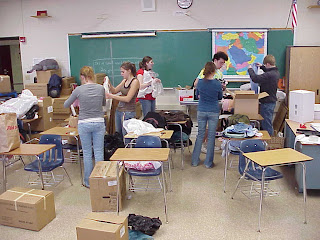
Opinion: What next for the Poly Squad?


Options:
1. Write a short proposal for a formal MHS club.
2. Sit around for a bit and talk politics (a la Stephanopoulous, George Will, et al.)
3. Immediately find another cause
4. Continue to work on the New Orleans cause
5. Choose several issues to educate ourselves on and then educate the (high school) public on (as it turns out this might be easy for us since we are pretty media-savvy! Journal Sentinel photo, article, Muskego article, and one TV report already!)
6. Discuss and prepare for AP exam
7. A comibination of all of these, none of these, and/or other stuff.
1. Write a short proposal for a formal MHS club.
2. Sit around for a bit and talk politics (a la Stephanopoulous, George Will, et al.)
3. Immediately find another cause
4. Continue to work on the New Orleans cause
5. Choose several issues to educate ourselves on and then educate the (high school) public on (as it turns out this might be easy for us since we are pretty media-savvy! Journal Sentinel photo, article, Muskego article, and one TV report already!)
6. Discuss and prepare for AP exam
7. A comibination of all of these, none of these, and/or other stuff.
8. Pack stuff in boxes and then open them again to find three specific items (p.s. I have the three items, Justin)
Sunday, March 04, 2007
Sunday, February 25, 2007
Saturday, February 17, 2007
What type of tasks/activities should the Poly Squad focus on and why? Also include your thought on what should be done with gathering items to send.
This is the Kenosha Tremper website for the Recovery Project:
http://www.trempergirlssoccer.com/recoveryproject.html
I believe that the Poly Squad should engage in task and/or activities that promote political awareness in this area, of events throughout the nation, not only events in our community, such as reminding our community of the disastrous hardships that many New Orleans residents are dragged through every day. The squad should help present both sides of issues, debating them fully, suggesting what should be done and taking action on issues, if a consensus is reached on what type of action should be taken. Poly Squad should get involved in issues affecting our community and other communities throughout the nation. It is so easy for people to feel very strongly about issues that affect them everyday, they are able to form a potent connection to the politics of the community and they sometimes forget issues affecting the state, region, nation, or different states, regions, or even nations. Reaching for these goals would also help our younger generation to get involved early in life, become more informed on political issues and help shape the future leaders of our community, state, region, or nation.As for the squad’s first undertaking, of gathering items for southern Louisiana residents, I feel that we may have some added success in gathering items for the gulf coast resident if we effectively play up the connections from the past, at this time of the year, with Fat Tuesday and Mardi gras. These festivities may help many people to recall seeing or hearing about past parties in New Orleans, and what a dynamic, lively, and vivacious city New Orleans was, and also recall the pictures of people sitting on the roofs of their houses, waiting for a boat to come past and rescue them. These recent memories of huge amounts of water taking over and engulfing everything, may strike a sentimental cord and contribute to the community’s generosity, in giving the everyday goods that are needed in the gulf coast region.
--Megan B.
http://www.trempergirlssoccer.com/recoveryproject.html
I believe that the Poly Squad should engage in task and/or activities that promote political awareness in this area, of events throughout the nation, not only events in our community, such as reminding our community of the disastrous hardships that many New Orleans residents are dragged through every day. The squad should help present both sides of issues, debating them fully, suggesting what should be done and taking action on issues, if a consensus is reached on what type of action should be taken. Poly Squad should get involved in issues affecting our community and other communities throughout the nation. It is so easy for people to feel very strongly about issues that affect them everyday, they are able to form a potent connection to the politics of the community and they sometimes forget issues affecting the state, region, nation, or different states, regions, or even nations. Reaching for these goals would also help our younger generation to get involved early in life, become more informed on political issues and help shape the future leaders of our community, state, region, or nation.As for the squad’s first undertaking, of gathering items for southern Louisiana residents, I feel that we may have some added success in gathering items for the gulf coast resident if we effectively play up the connections from the past, at this time of the year, with Fat Tuesday and Mardi gras. These festivities may help many people to recall seeing or hearing about past parties in New Orleans, and what a dynamic, lively, and vivacious city New Orleans was, and also recall the pictures of people sitting on the roofs of their houses, waiting for a boat to come past and rescue them. These recent memories of huge amounts of water taking over and engulfing everything, may strike a sentimental cord and contribute to the community’s generosity, in giving the everyday goods that are needed in the gulf coast region.
--Megan B.
Saturday, February 10, 2007
Opinion: Do you think the U.S. Senate should debate 0, 1, 2, or 3 of the resolutions about Iraq?
With all significant wars or approaches to war, elected leaders have gotten on record as to their beliefs. I remember teaching in U.S. History about how over months of debate every member of Congress gave their speech and got on record about the Compromise of 1850. With the importance of this miltary action to the lives of Americans, I think every elected official should say his or her opinion about it in what should be the most deliberative body on earth.
Sunday, February 04, 2007
Analysis: Will VP Cheney's power and/or status be diminished by the Scooter Libby trial?
By David IgnatiusFriday, February 2, 2007; Page A15
Why was the White House so nervous in the summer of 2003 about the CIA's reporting on alleged Iraqi attempts to buy uranium from Niger to build a nuclear bomb? That's the big question that runs through the many little details that have emerged in the perjury trial of Vice President Cheney's former top aide, Lewis "Scooter" Libby.
The trial record suggests a simple answer: The White House was worried that the CIA would reveal that it had been pressured in 2002 and early 2003 to support administration claims about Iraqi weapons of mass destruction, and that in the Niger case, the CIA had tried hard to resist this pressure. The machinations of Cheney, Libby and others were an attempt to weave an alternative narrative that blamed the CIA.The truth began to emerge on July 11, 2003, when CIA Director George Tenet issued a public statement disclosing that the agency had tried to warn the White House off the Niger allegations. In that sense, the Libby trial is about a cover-up that failed.
What helped start the whole brouhaha was a 2003 op-ed article by former ambassador Joseph Wilson, disclosing that his fact-finding trip to Niger the previous year had yielded no evidence of Iraqi uranium purchases. His piece opened with a devastating question: "Did the Bush administration manipulate intelligence about Saddam Hussein's weapons programs to justify an invasion of Iraq?" A frantic White House tried to rebut Wilson's criticism by leaking the fact that his wife, Valerie Plame, worked at the CIA and had suggested sending him to Niger -- as if the CIA connection somehow contaminated Wilson's allegations and made the White House less culpable.
To understand the Libby case, it's important to look at the documentary evidence, which has been usefully compiled by washingtonpost.com.
The record begins with a Feb. 13, 2002, memo from a CIA briefer who had been "tasked" by Cheney on the uranium issue: "The VP was shown an assessment (he thought from DIA) that Iraq is purchasing uranium from Africa. He would like our assessment of that transaction and its implications for Iraq's nuclear program." The CIA briefer responded the next day with a comment that should have aroused skepticism on whether Iraq needed to buy any more uranium: Iraq already had 550 tons of "yellowcake" ore -- 200 tons of it from Niger. But the CIA, eager to please, asked Wilson a few days later to go to Niger to investigate the claim.
A glimpse of the pressure coming from the vice president's office emerges from a memo from CIA briefer Craig R. Schmall, after he was interviewed in January 2004 by FBI agents investigating the leak of Plame's covert identity: "I mentioned also to the agents that Libby was in charge within the administration (or at least the White House side) for producing papers arguing the case for Iraqi WMD and ties between Iraq and al Qaeda, which explains Libby's and the Vice President's interest in the Iraq/Niger/Uranium case."
CIA and State Department documents show that analysts at both agencies became increasingly skeptical about the Niger allegation and tried to warn the White House. A memo from Schmall to Eric Edelman, then Cheney's national security adviser, recalled: "CIA on several occasions has cautioned . . . that available information on this issue was fragmentary and unconfirmed." A memo from Carl W. Ford Jr., then head of the State Department's intelligence bureau, noted that his analysts had found the Niger claims "highly dubious."
The Niger issue wasn't included in Secretary of State Colin Powell's famous U.N. speech on Iraqi weapons of mass destruction, according to Ford, "due to CIA concerns raised during the coordination regarding the veracity of the information on the alleged Iraq-Niger agreement." But despite CIA warnings, Bush referred to uranium purchases from Africa in his January 2003 State of the Union address, attributing it to British sources.
So we begin to understand why the White House was worried about the CIA in the summer of 2003: It feared the agency would breach the wall of silence about the claims regarding weapons of mass destruction. Robert Grenier, a CIA official who was the agency's Iraq mission manager, told colleagues that he remembered "a series of insistent phone calls" that month from Libby, who wanted the CIA to tell reporters that "other community elements such as State and DOD" had encouraged Wilson's Niger trip, not just Cheney.
The bottom line? Grenier was asked in court last week to explain the White House's 2003 machinations. Here's what he said: "I think they were trying to avoid blame for not providing [the truth] about whether or not Iraq had attempted to buy uranium." Let me say it again: This trial is about a cover-up that failed.
Why was the White House so nervous in the summer of 2003 about the CIA's reporting on alleged Iraqi attempts to buy uranium from Niger to build a nuclear bomb? That's the big question that runs through the many little details that have emerged in the perjury trial of Vice President Cheney's former top aide, Lewis "Scooter" Libby.
The trial record suggests a simple answer: The White House was worried that the CIA would reveal that it had been pressured in 2002 and early 2003 to support administration claims about Iraqi weapons of mass destruction, and that in the Niger case, the CIA had tried hard to resist this pressure. The machinations of Cheney, Libby and others were an attempt to weave an alternative narrative that blamed the CIA.The truth began to emerge on July 11, 2003, when CIA Director George Tenet issued a public statement disclosing that the agency had tried to warn the White House off the Niger allegations. In that sense, the Libby trial is about a cover-up that failed.
What helped start the whole brouhaha was a 2003 op-ed article by former ambassador Joseph Wilson, disclosing that his fact-finding trip to Niger the previous year had yielded no evidence of Iraqi uranium purchases. His piece opened with a devastating question: "Did the Bush administration manipulate intelligence about Saddam Hussein's weapons programs to justify an invasion of Iraq?" A frantic White House tried to rebut Wilson's criticism by leaking the fact that his wife, Valerie Plame, worked at the CIA and had suggested sending him to Niger -- as if the CIA connection somehow contaminated Wilson's allegations and made the White House less culpable.
To understand the Libby case, it's important to look at the documentary evidence, which has been usefully compiled by washingtonpost.com.
The record begins with a Feb. 13, 2002, memo from a CIA briefer who had been "tasked" by Cheney on the uranium issue: "The VP was shown an assessment (he thought from DIA) that Iraq is purchasing uranium from Africa. He would like our assessment of that transaction and its implications for Iraq's nuclear program." The CIA briefer responded the next day with a comment that should have aroused skepticism on whether Iraq needed to buy any more uranium: Iraq already had 550 tons of "yellowcake" ore -- 200 tons of it from Niger. But the CIA, eager to please, asked Wilson a few days later to go to Niger to investigate the claim.
A glimpse of the pressure coming from the vice president's office emerges from a memo from CIA briefer Craig R. Schmall, after he was interviewed in January 2004 by FBI agents investigating the leak of Plame's covert identity: "I mentioned also to the agents that Libby was in charge within the administration (or at least the White House side) for producing papers arguing the case for Iraqi WMD and ties between Iraq and al Qaeda, which explains Libby's and the Vice President's interest in the Iraq/Niger/Uranium case."
CIA and State Department documents show that analysts at both agencies became increasingly skeptical about the Niger allegation and tried to warn the White House. A memo from Schmall to Eric Edelman, then Cheney's national security adviser, recalled: "CIA on several occasions has cautioned . . . that available information on this issue was fragmentary and unconfirmed." A memo from Carl W. Ford Jr., then head of the State Department's intelligence bureau, noted that his analysts had found the Niger claims "highly dubious."
The Niger issue wasn't included in Secretary of State Colin Powell's famous U.N. speech on Iraqi weapons of mass destruction, according to Ford, "due to CIA concerns raised during the coordination regarding the veracity of the information on the alleged Iraq-Niger agreement." But despite CIA warnings, Bush referred to uranium purchases from Africa in his January 2003 State of the Union address, attributing it to British sources.
So we begin to understand why the White House was worried about the CIA in the summer of 2003: It feared the agency would breach the wall of silence about the claims regarding weapons of mass destruction. Robert Grenier, a CIA official who was the agency's Iraq mission manager, told colleagues that he remembered "a series of insistent phone calls" that month from Libby, who wanted the CIA to tell reporters that "other community elements such as State and DOD" had encouraged Wilson's Niger trip, not just Cheney.
The bottom line? Grenier was asked in court last week to explain the White House's 2003 machinations. Here's what he said: "I think they were trying to avoid blame for not providing [the truth] about whether or not Iraq had attempted to buy uranium." Let me say it again: This trial is about a cover-up that failed.
Saturday, January 20, 2007
Analysis: Washington D.C. Trip: date change.
$589 (unless there aren't enough people for that level, then it's more)
Leave Thursday May 17 after school
Return Sunday May 20 (late)
Bus trip, tour guide, meals, admission to attractions, lodging, our nation's capital: all included
Two hundred dollar deposit due in the next week
(I don't think I can go ($), but if you can, I highly recommend it. What an experience. If a majority of the class goes, we'll study the capital the week before departure. Personally, I like to know what I'm going to see before I see it.)
--Thanks to Dane, Ms. Yost, and AFS for changing the date to make this opportunity possible.--
Leave Thursday May 17 after school
Return Sunday May 20 (late)
Bus trip, tour guide, meals, admission to attractions, lodging, our nation's capital: all included
Two hundred dollar deposit due in the next week
(I don't think I can go ($), but if you can, I highly recommend it. What an experience. If a majority of the class goes, we'll study the capital the week before departure. Personally, I like to know what I'm going to see before I see it.)
--Thanks to Dane, Ms. Yost, and AFS for changing the date to make this opportunity possible.--
Wednesday, January 10, 2007
Sunday, January 07, 2007
Opinion: Why did you take AP Government and Politics?
(What are you saying to others to indicate that they should register for AP Government and Politics next year?)
Opinion: Which of the proposals for the Democrats first "100 Hours" will be the most important for the American people?
(Some proposals can be accomplished by just being enacted by the majority in the House, but some need the full process of becoming a law. Consider whether or not some proposals will become law and whether or not any of the proposals will actually benefit the people.)
Subscribe to:
Posts (Atom)